

Sunscreen Moisturizer: Buy the Sunscreen That Moisturizes, Not the Moisturizer With a Little SPF
The best sunscreen moisturizer is a real sunscreen first: "Broad Spectrum SPF 30" (or higher) printed on the label, water resistant, and built on a base rich enough that you can skip the separate cream. Then it needs a sunscreen's amount, which the American Academy of Dermatology sets at a teaspoon or more for the face. That second part is where most moisturizers with SPF come up short, because people spread them like moisturizer. So flip the product around. A mineral sunscreen made on a moisturizing base, like our grass-fed tallow SPF 30 tube, gives you the moisture and the full SPF in one step, as long as you put on enough.
Two very different products answer to "sunscreen moisturizer." One is a face cream that had a sunscreen active stirred in. The other is a sunscreen whose base happens to be good for your skin. On the shelf they look identical. On your face they behave differently, and most of the difference comes down to your hands.
Sunscreen moisturizer vs. moisturizer with SPF: why the word order matters
Anything sold in the US with an SPF claim is an over-the-counter drug, so both kinds carry a Drug Facts box and list an active ingredient. The labeling rule is strict. The claim has to read "Broad Spectrum SPF" followed by the number as one continuous phrase, and only a product that passed the broad-spectrum test gets to print it. Same paperwork, then. The habits around them are what split.
Is a moisturizer with SPF as good as sunscreen?
On paper, yes, if the SPF and the broad-spectrum claim match. In a real bathroom, less so. Researchers at the University of Liverpool had 84 adults apply a sunscreen on one visit and an SPF moisturizer on another, their normal way, with no coaching, then photographed them under a UV camera. With the moisturizer they missed 16.6% of the face on average, against 11.1% with sunscreen. Around the eyelids the gap was 20.9% versus 14.0%. The images also suggested people simply used less product when it was the moisturizer.
The best detail is the self-report. Before seeing their photos, 73 of the 84 agreed they had covered their whole face with the moisturizer. Nobody feels themselves under-applying. A cream that feels like skincare gets applied like skincare: one thin, polite layer and done.

For the record, the researchers liked the idea. Their conclusion was that adding SPF to daily moisturizers has "lots of potential advantages," mostly because people actually wear them every day, in any weather. The AAD makes the same trade-off: some moisturizers and cosmetics carry SPF, they're convenient, and you still need to reapply roughly every two hours outdoors. The idea is sound. The dose is the weak link, and we cover the order-of-operations side in sunscreen or lotion first.
How to pick a sunscreen moisturizer: 3 label checks
Ignore the front-of-jar adjectives. Flip it over and read these.
What SPF should a daily moisturizer have?
Check 1: SPF 30 or higher, with "Broad Spectrum" attached. The AAD recommends SPF 30 or higher for everyone and says SPF 30 filters 97% of the sun's UVB rays. Broad spectrum means it also passed a UVA test. And yes, wear it in November: the AAD notes up to 80% of the sun's UV gets through on cloudy days. Our deeper dive on the number itself is SPF 30 sunscreen cream: how to choose it and use it.
Check 2: water resistant, with a minute count. A sunscreen moisturizer you'll wear on a run or to the lake should say "Water Resistant (40 minutes)" or "Water Resistant (80 minutes)." Those are the only two versions the federal rule allows. "Waterproof," "sweatproof" and "sunblock" are on that same regulation's list of claims that misbrand a sunscreen, so a jar that leans on them hasn't read the rulebook.
Mineral or chemical sunscreen moisturizer for sensitive skin?
Check 3: the active, and what it's sitting in. If the active ingredient is zinc oxide, titanium dioxide or both, it's a mineral sunscreen, and that's the kind dermatologists recommend for sensitive skin, according to the AAD. (Our mineral sunscreen for sensitive skin checklist goes deeper, and zinc oxide vs. chemical sunscreen covers the filters.) Then read the inactive list, because that's the moisturizer half of the product. Plenty of daily SPF creams are built on water, held together with emulsifiers and kept fresh with preservatives, with the good stuff somewhere in the middle. A waterless base works differently: the fats carry the zinc, and there's no water in there to guard. Our tube has no water at all, and sea buckthorn oil helps keep the formula stable without synthetic preservatives. The full lineup is on our ingredients page.

What about a tinted moisturizer with SPF?
Same three checks. Most people reach for a tinted one to dodge the ghostly white cast of plain zinc, which is a fair reason. Our Tinted Sunscreen Tube handles that with a very light organic cocoa powder tint instead of iron oxides or dyes, so the zinc rubs in warm. The tint is there to make the sunscreen disappear, not to cover anything, which is the whole point: you can wear a full teaspoon of it and still look like you. More on how that works in tinted tallow sunscreen.
Why tallow makes the better sunscreen moisturizer base
Here's where we get to brag a little. Tallow is rendered beef fat, and its fatty-acid lineup reads like a list of what's already in your skin. A 2024 scoping review in Cureus describes tallow as rich in oleic, palmitic, stearic and linoleic acids, and cites work naming palmitic, stearic, oleic and linoleic acids among the main fatty acids of the epidermis. Its read on the evidence: tallow "looks to be biocompatible" and offers "hydrating and moisturizing properties." We wrote up the moisture side in benefits of beef tallow moisturizer.
That handles the moisturizer half. Tallow also turns out to be a great ride for zinc. Zinc oxide on its own is chalky, and in a thin base it tends to drag. Tallow has slip. It softens the finish so the zinc spreads in one even layer, and with mineral sunscreen an even layer is the whole game, since a streak is a gap.
Our tube carries non-nano zinc oxide, its only active, in grass-fed beef tallow and plant oils, with shea and cocoa butter for body. One reviewer, patricia m., summed it up better than we could: "Zinc oxide tends to dry my skin out horribly but this formula does not dry me out."
Does beef tallow have SPF on its own?
Not a number you could print on a label. SPF is measured on a finished sunscreen, so in our tube the zinc earns the SPF 30 and the tallow does what it's best at: keeping your face comfortable while you wear it all day. That division of labor is what a good sunscreen moisturizer looks like. The longer version is in does beef tallow sunscreen work.
How to use a sunscreen moisturizer so you get the SPF on the label
The SPF number on any label comes from a test that applies 2 milligrams of product per square centimeter of skin. For a face, the AAD's practical version is at least a teaspoon, or about enough to cover the length of your index and middle fingers. Use half and you don't get SPF 30. You get some smaller number nobody measured.
So the routine is short. Shake the tube first, because the zinc settles between uses. Squeeze out two finger-lengths for your face, about 15 minutes before you head out, and rub it in everywhere, eyelids included. Then go after the inner corners of your eyes: in the Liverpool study, 66 of 84 people missed that little hollow beside the nose, and it was just as bad with sunscreen as with the SPF moisturizer. Give it about five minutes before you pull a shirt over your head, because a tallow base can transfer to fabric while it's still on the surface. Outdoors, reapply about every two hours, and again after swimming, sweating or towel drying.

Should I put moisturizer under a sunscreen moisturizer?
For most faces, no. A tallow-based sunscreen is the moisturizer step, and it goes on last in the morning. If your skin runs properly dry, or the heating has been on all week, put a cream on first, give it about a minute, then sunscreen on top. That two-step version is laid out in tallow moisturizer + sunscreen: how to use.
Quick answers
Is a moisturizer with SPF enough for everyday use?
It can be, if the label says Broad Spectrum SPF 30 or higher and you use a sunscreen-sized amount: at least a teaspoon for the face. Most people don't. In a UV-camera study of 84 adults, an SPF moisturizer left 16.6% of the face uncovered, against 11.1% for regular sunscreen.
What is the best natural sunscreen moisturizer?
Look for a mineral active (zinc oxide or titanium dioxide), Broad Spectrum SPF 30 or higher, water resistance, and an inactive list you can read out loud. Ours pairs non-nano zinc oxide with grass-fed beef tallow and plant oils, with no water in the base.
Can a tinted moisturizer with SPF replace sunscreen?
Only if it passes the same checks: Broad Spectrum SPF 30 or higher, and enough of it on your face. A heavy tint can tempt you to go thin, since a full layer starts to look like makeup. A sunscreen with a very light tint, like our cocoa-tinted tube, lets you use the whole amount without looking painted.
Does beef tallow have SPF?
Not one you could print on a label. SPF is a tested number for a finished sunscreen, and in our tube the non-nano zinc oxide earns the SPF 30 while the tallow does the moisturizing. That split is exactly what a sunscreen moisturizer should be.
Do I need a separate moisturizer under a sunscreen moisturizer?
Usually not, if the sunscreen's base is rich, like tallow with shea and cocoa butter. On very dry days, apply a cream first, give it about a minute to sink in, then put the sunscreen on as the last step.
How often should I reapply a sunscreen moisturizer?
About every two hours when you're outdoors, and after swimming, sweating or towel drying. A morning layer doesn't carry you through a whole day outside, however nice it feels. Our tube is labeled water resistant (80 minutes).
The sunscreen moisturizer we make
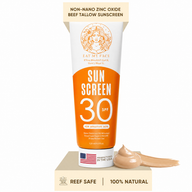
Our Beef Tallow Tinted Sunscreen Tube SPF 30 is a mineral sunscreen with one active, non-nano zinc oxide, carried in grass-fed beef tallow and organic plant oils instead of water. Broad spectrum, water resistant (80 minutes), a very light organic cocoa tint so it rubs in warm, and a 4 oz squeeze tube made in Eugene, Oregon. Rather skip the tint? The Untinted Sunscreen Tube has the same active and SPF 30, no cocoa powder.
The AAD points out that if you use sunscreen every day in the right amount, a bottle shouldn't last long. At a teaspoon a morning, a 4 oz tube is roughly 24 face days, which is why the SPF 30 Sunscreen Tube 2-Pack exists.
On dry days, put a cream under it. The Baby & Momma Cream is the fragrance-free one, built on grass-fed beef tallow, shea butter, cocoa butter, arrowroot powder, sea buckthorn oil, vitamin E, jojoba oil, fractionated coconut oil and cetyl alcohol.
Sources
- American Academy of Dermatology. "Sunscreen FAQs." aad.org/media/stats-sunscreen
- Lourenco EAJ, Shaw L, Pratt H, Duffy GL, Czanner G, Zheng Y, Hamill KJ, McCormick AG. "Application of SPF moisturisers is inferior to sunscreens in coverage of facial and eyelid regions." PLoS One, 2019. PMC6447356
- Russell MF, Sandhu M, Vail M, Haran C, Batool U, Leo J. "Tallow, Rendered Animal Fat, and Its Biocompatibility With Skin: A Scoping Review." Cureus, 2024. PMC11193910
- 21 CFR 201.327, "Over-the-counter sunscreen drug products; required labeling based on effectiveness testing." Legal Information Institute, Cornell Law School. law.cornell.edu/cfr/text/21/201.327
Ready to try it? Beef Tallow Tinted Sunscreen Tube SPF 30 is in stock and ships fast — $24.99. 180 days to decide.

