

SPF 30 Sunscreen Cream: How to Choose It and Use It So You Get the Full 30
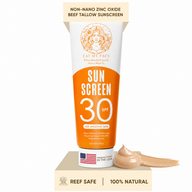
An SPF 30 sunscreen cream filters about 97 percent of the sun's UVB when you put on enough of it, and SPF 30 is the floor the American Academy of Dermatology sets for anything you wear outside. A good one says "Broad Spectrum SPF 30" on the front, carries a Drug Facts panel naming its active ingredient, and states a water-resistance time of 40 or 80 minutes. For a mineral cream, that active is zinc oxide. Use a full teaspoon on your face, apply it 15 minutes before you go out, and reapply every two hours. Ours is a grass-fed beef tallow cream with non-nano zinc oxide as its single active, in a 4 oz squeeze tube with a light organic cocoa tint.
That paragraph is the whole answer. The rest of this page is why each piece matters, because the number on the tube is only half the story. The other half is how you use it. If you want the long version of how a tallow mineral sunscreen is put together, the complete guide to tallow mineral sunscreen has it.
What "SPF 30" on a sunscreen cream actually means
SPF measures one thing: how much UVB reaches your skin through the sunscreen compared with bare skin. SPF 30 means roughly one-thirtieth gets through. Call it 3 percent. The American Academy of Dermatology puts it the other way around: SPF 30 "blocks 97% of the sun's UVB rays."
Run the same arithmetic up and down the shelf and the pattern is obvious. SPF 15 lets about 7 percent through. SPF 30 lets about 3 percent through. An SPF 50 on another brand's label lets about 2 percent through. The jump from 15 to 30 cuts what reaches you by more than half. The jump from 30 upward trims a single percentage point. That is the whole difference, and it is smaller than the difference between a full teaspoon and the dab most people actually use.

One more thing the number does not do: buy you time. The AAD is blunt about it. "A high-number SPF does not allow you to spend additional time outdoors without reapplication." A higher number is not a longer leash. Two hours is two hours, whatever the tube says.
Is SPF 30 enough for your face?
Yes. It is the number dermatologists recommend as a minimum, and it is the number most daily-wear sunscreen creams are built around for a reason. It filters 97 percent of UVB in a formula you will actually wear every day, which is the part that matters. A sunscreen that lives in the drawer because it feels like paste is SPF 0.
Is SPF 30 enough for the beach?
Yes, with two conditions. Pick a cream labeled water resistant for 80 minutes, and treat those 80 minutes as a timer rather than a suggestion. Reapply when you come out of the water, after you towel off, and every two hours regardless. A beach day is not where SPF 30 comes up short. It is where skimping and forgetting come up short, and no number on a tube fixes those.
Cream, lotion, spray or stick: why cream wins for the face
Sunscreen comes in a lot of formats, and the physics are the same in all of them. The difference is how reliably you get a full, even layer onto your skin. A cream is the easiest format to dose. You can see where it went, you can feel the thickness, and you are not depending on a nozzle or the wind. Sprays are notorious for thin, patchy coverage, and nobody wants to breathe their sunscreen. Sticks are handy for a nose or an ear but slow for a whole face. Lotions are fine, but they are thinner by design, so a "generous" squeeze of lotion is often less product than it looks.
A tallow-based cream goes a step further. There is no water in the formula. The base is grass-fed beef tallow and plant oils, which means the zinc oxide is carried in something your skin already recognizes. Tallow is rich in oleic, palmitic, stearic and linoleic fatty acids, and a 2024 scoping review in Cureus notes that palmitic, stearic, oleic and linoleic acids are also key fatty acids in the human epidermis. That is the whole biocompatibility argument in one sentence. The same review found tallow has "hydrating and moisturizing properties." Translation: an SPF 30 tallow cream is also your morning moisturizer. One step, not two.
The inactive list on our tube reads grass-fed beef tallow, coconut oil, jojoba oil, sea buckthorn oil, shea butter, cocoa butter, cacao powder, arrowroot powder, beeswax, cetyl alcohol, vitamin E and vanilla. Add the zinc and that is the entire formula, and most of it you would recognize from a pantry.
What active ingredient should a natural SPF 30 face sunscreen use?
Zinc oxide, and ideally only zinc oxide. Of the two mineral filters, titanium dioxide works mainly in the UVB range, while zinc oxide is "more efficient in UVA absorption," per a 2011 review in Nanotechnology, Science and Applications. Zinc covers both ends on its own, which is why a zinc-only cream can carry the Broad Spectrum label without a second active. It also means the Drug Facts panel is one line long. No oxybenzone, no octinoxate, no octocrylene, no avobenzone.
Non-nano matters too. Non-nano zinc oxide particles are large enough to sit on top of your skin and soak up UV before it reaches you, rather than soaking into it the way chemical filters can. That is the real difference between a mineral cream and a chemical one, and it is why the AAD says dermatologists "recommend physical sunscreens, also called mineral sunscreens, for people with sensitive skin." The trade-off is a white cast, and that is where the cocoa comes in. Our tube uses a very light organic cocoa tint so the zinc rubs in warm instead of ghost-white. It smells like cocoa and vanilla because that is what is in it.
How do you read an SPF 30 sunscreen label?
Reading the front of the tube takes ten seconds once you know what counts. Sunscreen is regulated as an over-the-counter drug, and the labeling rule (21 CFR 201.327) allows exactly two water-resistance claims: "Water Resistant (40 minutes)" and "Water Resistant (80 minutes)." The same rule lists "sunblock," "sweatproof" and "waterproof" as claims that make a product misbranded. So if a tube says any of those three, the company either does not know the rules or is hoping you do not. And a "sun balm" with no SPF number and no Drug Facts panel is a moisturizer with a suntan. It has not been through the SPF test, so it cannot tell you what it does. The plain-tallow-as-sunscreen question has a clear answer: the zinc does the work, and the tallow is the base that makes it wearable.

How to use an SPF 30 sunscreen cream so you actually get SPF 30
The SPF number comes from a standardized test at a fixed, generous dose. Use less and you are wearing a smaller number than the tube says. That is the single most common sunscreen mistake, and most people use about half of what the test assumes.
Here is the dose, straight from the AAD. Face: "at least 1 teaspoon (about the amount needed to cover the length of your index and middle fingers)." Body: "about 1 ounce of sunscreen, roughly the amount to fill a shot glass." Apply it to dry skin 15 minutes before going outdoors. With a tube like ours, shake it first, squeeze onto your fingertips, and work in sections: forehead, cheeks, nose, chin, then the bits everyone misses, which are ears, the back of the neck, and the tops of your feet if they are seeing daylight.
Then the clock. Reapply "approximately every two hours, or after swimming or sweating," as the AAD puts it. Water resistant 80 minutes means the SPF held through 80 minutes of water in testing. After that, or after a towel, you start over. Our water-resistance explainer goes deeper on what that label does and does not promise.

How long does SPF 30 last?
About two hours on skin, and 80 minutes in the water for an 80-minute water-resistant cream. The number has nothing to do with duration. It describes how much UVB gets through while the layer is intact, and sweat, water, towels and your own hands thin that layer. So the two-hour rule applies to SPF 30 and to every higher number equally.
Can you still tan with SPF 30?
Yes. About 3 percent of UVB still gets through a properly applied SPF 30, so skin still tans, just more slowly than it would bare. Dermatologists will tell you a tan is your skin responding to UV damage, so "slower" is the point. No SPF makes tanning safe. What SPF 30 changes is how fast it happens and how much your skin takes on along the way.
Quick answers
Is SPF 30 enough for everyday use?
Yes. The American Academy of Dermatology recommends at least SPF 30 for daily wear, and SPF 30 filters about 97 percent of UVB when you apply a full teaspoon to your face. Reapplying every two hours matters far more than chasing a higher number.
What is the difference between SPF 30 and a higher SPF?
About one percentage point of UVB. SPF 30 lets roughly 3 percent through, while an SPF 50 from another brand lets roughly 2 percent through. Neither one lasts longer on your skin, and both need reapplying every two hours.
How much SPF 30 cream should I put on my face?
At least a teaspoon, which is about the length of your index and middle fingers in cream. Apply it to dry skin 15 minutes before heading out, and do not skip ears, neck and hairline. Using half the amount leaves you wearing far less than SPF 30.
Can you still tan wearing SPF 30?
Yes, slowly. Roughly 3 percent of UVB gets through, and that is enough for skin to darken over time. No sunscreen makes tanning safe. SPF 30 lowers the dose your skin takes each hour, which is exactly what you want from it.
Is a mineral SPF 30 cream good for sensitive skin?
Dermatologists recommend physical, or mineral, sunscreens for sensitive skin, according to the AAD. Non-nano zinc oxide sits on the skin's surface instead of soaking in, and a tallow base brings the same fatty acids your skin already makes. If you are shopping for the whole family, our guide to tallow for kids covers the same ground.
Is SPF 30 enough for tattoos?
Yes. Ink fades because UV breaks down pigment, and a broad-spectrum SPF 30 mineral cream, reapplied on schedule, cuts the UV reaching the ink by the same 97 percent it cuts everywhere else. We wrote up tallow sunscreen for tattoos in detail.
The SPF 30 sunscreen cream we make
The Beef Tallow Tinted Sunscreen Tube SPF 30 is a reef-safe mineral cream with one active, non-nano zinc oxide, carried in grass-fed beef tallow and organic plant oils instead of water. Broad spectrum, water resistant 80 minutes, a very light organic cocoa tint, 4 oz squeeze tube, made in small batches in Eugene, Oregon. Shake, squeeze, rub in, go outside.
The Baby & Momma Cream is the fragrance-free one, built on grass-fed beef tallow, shea butter, cocoa butter, arrowroot powder, sea buckthorn oil, vitamin E, jojoba oil, fractionated coconut oil and cetyl alcohol.
Sources
- American Academy of Dermatology, "Sunscreen FAQs." aad.org
- Smijs TG, Pavel S. "Titanium dioxide and zinc oxide nanoparticles in sunscreens: focus on their safety and effectiveness." Nanotechnology, Science and Applications, 2011. PMC3781714
- Russell MF, Sandhu M, Vail M, Haran C, Batool U, Leo J. "Tallow, Rendered Animal Fat, and Its Biocompatibility With Skin: A Scoping Review." Cureus, 2024. PMC11193910
- 21 CFR § 201.327, "Over-the-counter sunscreen drug products; required labeling based on effectiveness testing." Cornell Legal Information Institute
Ready to try it? Beef Tallow Tinted Sunscreen Tube SPF 30 is in stock and ships fast — $24.99. 180 days to decide.

