

Mineral Sunscreen for Sensitive Skin: 5 Label Checks Before It Touches Your Face
The best mineral sunscreen for sensitive skin uses zinc oxide as its only active ingredient, keeps the rest of the label short, and leaves out the chemical UV filters that soak into your skin to do their job. The American Academy of Dermatology recommends mineral sunscreens for people with sensitive skin, and zinc covers UVA better than titanium dioxide does. Pick one that passes the five label checks below, then patch-test it for seven to ten days before it goes on your face.
That's the whole answer. The rest of this page is the why, and the part most sunscreen guides skip: how to read a label so the next bottle doesn't end up at the back of the bathroom cabinet with the other four.
Sensitive skin is the majority, not the exception
If your face stings, burns or tingles after products that seem to be fine for everyone else, you're in a crowd. A 2019 review in Frontiers in Medicine pulled together prevalence studies from around the world and found that roughly 60 to 70% of women and 50 to 60% of men report some degree of sensitive skin. The working definition is refreshingly plain: unpleasant sensations, like stinging, burning and tingling, in response to things that shouldn't cause them.
Here's the bad luck. The same review lists the usual triggers, and two of them are sun exposure and personal care products. Sunscreen is a personal care product you put on because of the sun. So if you have reactive skin, the bottle meant to calm one trigger can easily become the other. That's why the formula matters more for you than for the friend who can wear anything.

Why a mineral sunscreen for sensitive skin beats chemical filters
Every sunscreen does its work with one of two kinds of active ingredient. Chemical filters (oxybenzone, avobenzone, octinoxate and friends) absorb into the skin and soak up UV from inside it. Mineral filters, zinc oxide and titanium dioxide, stay on the surface and soak up UV right there, before it reaches you. Zinc absorbs about 95% of the UV it meets and scatters the rest, which is a lot less "tiny mirrors" than the old ads claimed, and a lot more useful.
The AAD's own sunscreen FAQ puts it simply: if the active is zinc oxide, titanium dioxide or both, you have a physical sunscreen, and dermatologists recommend physical sunscreens, also called mineral sunscreens, for people with sensitive skin. If you want the long version of how the two families differ, our zinc oxide vs chemical sunscreen explainer walks through it filter by filter.
Is chemical sunscreen bad for sensitive skin?
Not for everyone. Plenty of people wear chemical filters with zero drama. But if you've ever had a sunscreen sting your eyes or leave your cheeks hot and blotchy, a chemical filter soaking in is the usual suspect, and switching to zinc-only is the simplest experiment you can run. One variable, one change.
Zinc oxide or titanium dioxide?
Both are minerals, but they aren't twins. A review of the two in Nanotechnology, Science and Applications describes titanium dioxide as primarily a UVB absorber, while zinc oxide is more efficient in UVA absorption. UVA is the deeper, aging part of sunlight, and it gets through window glass. Zinc on its own can carry broad-spectrum coverage, which means a zinc-only formula doesn't need a second filter to fill the gap.
The 5 label checks before it touches your face
Turn the bottle over. Everything you need is on the back, in two boxes: the Drug Facts panel (the actives) and the inactive ingredients.
1. One active, and it's zinc oxide
Look at the Active Ingredients line. You want zinc oxide, ideally alone. Watch for the hybrids the AAD mentions: sunscreens that mix a mineral with one or more chemical filters and still put "mineral" on the front. The front of the bottle is marketing. The back is the law.
2. Non-nano zinc, and an honest answer about white cast
Non-nano particles are large enough to stay on the surface of your skin, which is the whole point of going mineral. The trade-off is visibility. The same Nanotechnology review explains that particles smaller than about half the wavelength of visible light look transparent, and that swapping regular zinc for nanoparticles buys that transparency at the expense of broad UVA protection. So a little cast is the price of the good stuff. A light tint is the workaround. More on that in our non-nano zinc and white cast guide.
3. A short inactive list you can actually read
Every extra ingredient is one more thing your skin gets a vote on. Sensitive skin rewards boring labels: fewer ingredients, fewer surprises, and it's much easier to work out what bothered you if something does. Our guide to natural skincare for sensitive skin applies the same rule to the rest of the routine.
4. What's carrying the zinc
Zinc is a powder. Something has to spread it. In most sunscreens that something is water plus emulsifiers, and anything with water in it needs a preservative system to keep microbes out. A sunscreen built on fats and oils instead of water skips that problem. This is where tallow earns its place: a 2024 scoping review in Cureus describes tallow as rich in oleic, palmitic, stearic and linoleic acids, the same family of fatty acids your skin's outer layer is built from. It spreads warm, it carries the zinc evenly, and it leaves skin feeling moisturized rather than coated in chalk.
5. "Fragrance free" vs "unscented"
These are not the same word. The AAD's advice for anyone whose skin reacts to fragrance is to choose products labeled fragrance free, and to stay cautious with products labeled unscented or full of plant botanicals, since those can still carry fragrance-related ingredients. If scent is your known trigger, that's the line to read. If it isn't, a sunscreen that smells like what's actually in it (cocoa, say) is a different thing from one that smells like a perfume counter.

How to try a new mineral sunscreen without starting a fight
Even a well-built formula deserves an audition. The AAD's patch-test method is simple: put a quarter-sized amount on a spot where it won't be rubbed or washed off, like the underside of your arm or the bend of your elbow, twice a day for seven to ten days. Use the same amount and thickness you'd use for real. No redness, itching or swelling by the end? It's cleared for your face.
Then apply it like you mean it. Shake mineral formulas first, because zinc settles. Use at least a teaspoon for your face (the AAD's measure is about the length of your index and middle fingers), on dry skin, 15 minutes before you head out. Smooth it in with your palms instead of scrubbing; reactive skin doesn't love friction. Give it a few minutes to sink in before you pull on a shirt. Reapply about every two hours, and after swimming or sweating. If you're layering a moisturizer, it goes on first, and our sunscreen-or-lotion-first guide explains why. If you tend to under-apply (almost everyone does), read how much sunscreen you actually need.

Oily and sensitive at the same time? You can still go mineral. Our sunscreen for oily skin rules cover how to keep a rich base from feeling heavy, and the mineral sunscreen for face guide goes deeper on finish and rub-in.
The one we make for sensitive skin
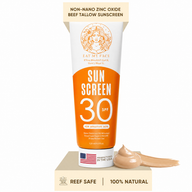
Beef Tallow Tinted Sunscreen Tube, SPF 30
We built this tube around the first four checks. One active: non-nano zinc oxide, broad spectrum SPF 30, water resistant for 80 minutes. No chemical filters, no water, and no synthetic preservatives (sea buckthorn oil keeps the formula stable). The base is grass-fed beef tallow with organic shea and cocoa butter, and a very light tint of organic cocoa powder so the zinc rubs in warm instead of ghost-white. It smells like cookies because cocoa and vanilla oleoresin are what's in it, not a fragrance blend. Every ingredient is food-grade, and it's made in Eugene, Oregon. See the full list of what we leave out on our ingredients page.
Get the Tinted SPF 30 Tube or grab the SPF 30 Tube 2-Pack so there's one in the bag and one by the sink.
Need a moisturizer to go under it? The Baby & Momma Cream is the fragrance-free one, built on grass-fed beef tallow, shea butter, cocoa butter, arrowroot powder, sea buckthorn oil, vitamin E, jojoba oil, fractionated coconut oil and cetyl alcohol.
Quick answers
Is mineral sunscreen better for sensitive skin?
For most people with reactive skin, yes. The AAD says dermatologists recommend physical, or mineral, sunscreens for people with sensitive skin. A zinc-only formula leaves chemical filters out entirely, so there is nothing soaking in.
Is a zinc oxide body sunscreen better for sensitive skin?
The same logic applies below the neck. Zinc sits on the surface instead of soaking in, wherever you put it. Budget about an ounce for full-body coverage, roughly a shot glass, so a 4 oz tube covers about four full-body applications.
What is the best sunscreen alternative for sensitive skin?
If chemical filters are what bother you, the alternative is a mineral sunscreen, not skipping sunscreen. Pair it with shade, a hat and clothing. Dermatologists recommend sunscreen on all skin not covered by clothing, every day.
Is "fragrance free" the same as "unscented"?
No. The AAD tells people who react to fragrance to choose products labeled fragrance free and to be cautious with "unscented" products, which can still contain fragrance-related ingredients. Read the inactive list, not just the front.
Does non-nano zinc oxide leave a white cast?
A little, because the particles are large enough to stay on top of your skin and stay visible. Shrinking them to nanoparticles makes them transparent but costs UVA coverage. A light tint, like organic cocoa powder, helps the zinc blend in.
How much mineral sunscreen should I put on my face?
At least one teaspoon, about the length of your index and middle fingers. Apply it to dry skin 15 minutes before going outside and reapply about every two hours, or after swimming or sweating.
Sources
- American Academy of Dermatology. "Sunscreen FAQs." aad.org/media/stats-sunscreen
- American Academy of Dermatology. "How to test skin care products." aad.org
- Farage MA. "The Prevalence of Sensitive Skin." Frontiers in Medicine, 2019. PMC6533878
- Smijs TG, Pavel S. "Titanium dioxide and zinc oxide nanoparticles in sunscreens: focus on their safety and effectiveness." Nanotechnology, Science and Applications, 2011. PMC3781714
Ready to try it? Beef Tallow Tinted Sunscreen Tube SPF 30 is in stock and ships fast — $24.99. 180 days to decide.

