

Does Beef Tallow Work as Sunscreen? The Honest 2026 Answer
Updated July 2026.
Does beef tallow sunscreen work? Yes — when non-nano zinc oxide is the active ingredient. Tallow is the base; zinc does the protecting. Zinc oxide absorbs roughly 95% of the UV that hits it (it does not “reflect” rays, whatever the internet told you) and delivers broad-spectrum SPF 30. Plain tallow on its own? Not a sunscreen — no SPF, no UV protection, full stop. Our beef tallow sunscreen SPF 30 is a real, labeled sunscreen: non-nano zinc oxide in grass-fed tallow, reef-safe, water-resistant for 80 minutes.
If you're new to tallow on the face, start with our ranked guide to the best beef tallow for face — benefits, routines, ingredients to avoid, and recommended products by skin type.
At Eat My Face, we follow one rule: If you wouldn't eat it, don't wear it. That's why our formulas use real, recognizable ingredients and skip the chemical-filter cocktail.
Short answer: Beef tallow sunscreen is a mineral sunscreen that uses grass-fed beef tallow as the base and non-nano zinc oxide as the active ingredient that does the protecting. It works when it is a real, labeled sunscreen: broad-spectrum SPF 30 on the label, a Drug Facts panel on the package, and a water-resistance rating (ours is 80 minutes). Plain tallow straight from the jar has no SPF, so a "tallow sun balm" with no Drug Facts panel is a moisturizer, not sun protection.
Short answer: does beef tallow work as sunscreen?
On its own, no. Plain beef tallow has no meaningful SPF — raw animal fats test around SPF 1–4, basically a rounding error against UV. Tallow is a wonderful moisturizer and after-sun balm, but it does not block ultraviolet rays.
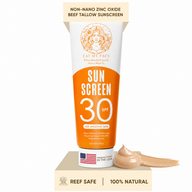
What actually works is a mineral tallow sunscreen: a grass-fed tallow base carrying non-nano zinc oxide — the mineral active that absorbs about 95% of UVA and UVB and turns it into a trace of heat — formulated and tested to a real SPF 30. That is the difference between "tallow" and "tallow sunscreen." Our beef tallow sunscreen SPF 30 is reef-safe and made in the USA, on ingredients clean enough to eat.
Tallow "sun balm" vs. tested sunscreen: the difference nobody tells you
A lot of tallow products marketed for sun are balms with zinc stirred in — and many openly state they are not tested sunscreens and legally can't claim an SPF. In the US, a real sunscreen is an FDA-regulated OTC drug: tested SPF, broad-spectrum verification, and a Drug Facts panel on the package.
Five things a real tallow sunscreen shows you (and an untested balm can't):
- A labeled SPF number backed by testing, not vibes
- "Broad spectrum" printed on the label (UVA + UVB)
- A Drug Facts panel listing the active ingredient
- A water-resistance rating (40 or 80 minutes) if one is claimed
- Reapplication directions straight from the label, not a blog post
Our SPF 30 mineral tube and 4 oz tin are real, labeled sunscreens with a Drug Facts panel. To see how the major tallow SPFs stack up side by side, here are the 2026 tallow sunscreen rankings.
One label question deserves its own page: what an organic tallow sunscreen label can and can't promise — the certification fine print, minus the marketing.
What Actually Makes A Sunscreen "Work"
For sunscreen to "work," it needs:
-
An active UV filter (mineral zinc oxide or titanium dioxide)
-
Broad-spectrum coverage (UVA + UVB)
-
Enough application + reapplication to maintain protection
So does beef tallow sunscreen work? It works when the formula uses non-nano zinc oxide for mineral protection and you apply it correctly. Weighing tallow against other options? Our guide to natural sunscreen alternatives ranks what actually protects you and what only sounds like it does.
Why Beef Tallow Is A Great Sunscreen Base
Beef tallow (especially grass-fed beef tallow) is naturally rich in skin-supporting fatty acids and vitamins A, D, E, and K. As a base, it can help:
-
Reduce the dry, tight feeling some mineral sunscreens cause
-
Support the skin barrier while you're out in sun + wind
-
Improve comfort for sensitive skin (when the ingredient list is clean)
-
Make daily SPF easier to stick with (which is the real win)
That's why people love tallow-based mineral SPF: it's protection that feels like nourishment.
More on the vitamins A, D, E & K in tallow and what each one does for your skin.
Why Non-Nano Zinc Oxide Matters
Non-nano zinc oxide sits on the skin's surface and absorbs about 95% of UV rays, scattering the small remainder. It's a popular choice for:
-
Sensitive skin
-
Kids and families (with proper usage)
-
Reef-conscious shoppers who want to avoid certain chemical filters
Our SPF 30 tallow sunscreen uses non-nano zinc oxide as its sole active ingredient — formulated to deliver broad-spectrum SPF 30 protection while the tallow base keeps it comfortable to wear. You can see the whole lineup in our beef tallow sunscreen collection.
Reading a label and trying to work out whether the zinc number actually adds up? We took apart what happens without it — is tallow sunscreen effective without zinc — ingredient panel by ingredient panel.
So when someone asks, does beef tallow sunscreen work, the best answer is: Yes—when it's a mineral sunscreen powered by non-nano zinc oxide.
How To Get The Best Results (So It Truly Works)
To make sure your sunscreen performs:
-
Apply generously to face, neck, ears, and exposed skin
-
Reapply every 2 hours outdoors
-
Reapply after swimming, sweating, or toweling off
-
Don't forget high-fade zones: nose, cheeks, shoulders, tops of hands
The Bottom Line
Does Beef Tallow Sunscreen Work? Yes—when it's built around non-nano zinc oxide for broad-spectrum mineral SPF and backed by a clean, nourishing tallow base. If you want sun protection that's non-toxic, reef-conscious, and comfortable enough to wear every day, tallow-based mineral sunscreen is one of the best options out there. For more options, read our guide to natural sunscreen alternatives.
If you're ready to try it, shop our SPF 30 Beef Tallow Sunscreen and keep it simple: protect daily, reapply, and replenish after sun. If you wouldn't eat it, don't wear it.
Hungry to learn more about beef tallow for skincare? Check out our Skin Nutrition Journal.
Shop natural sun care and sun recovery here
Check out Eat My Face's full line of natural skincare that's good enough to eat here.
Protect your skin: Our SPF 30 Beef Tallow Sunscreen — reef-safe, mineral, SPF 30.
Can beef tallow be used as sunscreen on its own?
Beef tallow can be used as sunscreen when it is formulated with a mineral active, and that is exactly the version we make: non-nano zinc oxide carried in a grass-fed tallow base, labeled broad-spectrum SPF 30, reef-safe and water-resistant for 80 minutes. Plain tallow straight from the jar is a fantastic moisturizer and after-sun step, but raw animal fats test around SPF 1 to 4, so on its own it is not sun protection. Tallow is the base that keeps zinc from feeling like paste, and zinc does the protecting. Practical check: if the tin does not list an active ingredient and an SPF number, it is a moisturizer, not a sunscreen.
Beef tallow sunscreen: frequently asked questions
Does plain beef tallow have an SPF?
No meaningful one. Raw animal fats test around SPF 1–4 — nowhere near real protection. Tallow is a great moisturizer and after-sun step, but UV protection has to come from a tested mineral active like non-nano zinc oxide.
Does beef tallow have SPF?
No. Plain beef tallow has no SPF and provides no UV protection. Only the zinc oxide active in a tested tallow sunscreen protects you.
What zinc oxide is in Eat My Face tallow sunscreen?
Non-nano zinc oxide (Z-Cote by BASF) — the sole active, delivering broad-spectrum SPF 30. The exact percentage is printed on the Drug Facts panel on the package.
Is beef tallow sunscreen reef-safe?
Yes. Our beef tallow sunscreen uses non-nano zinc oxide as its only active — no oxybenzone or octinoxate, the chemical filters restricted in reef-protection zones like Hawaii and Key West. The grass-fed tallow base is edible-grade and biodegradable.
What SPF is Eat My Face tallow sunscreen?
It's broad-spectrum SPF 30, made in the USA and packaged in a travel-friendly 4 oz squeeze tube.
Does tallow sunscreen leave a white cast?
Mineral (zinc oxide) sunscreens can leave a light cast, but the grass-fed tallow base helps it blend and melt into skin instead of sitting on top. Rub it in fully and give it a minute to settle.
Is beef tallow sunscreen good for sensitive skin?
Tallow's fatty-acid profile is close to human sebum, so the base tends to feel comfortable on reactive skin, and non-nano zinc oxide sits on the surface rather than soaking in. As with any new product, patch test first.
How much tallow sunscreen should I apply?
More than you think. To actually get the SPF 30 on the label, use about a quarter-teaspoon for your face and neck — the “two-finger rule,” a full strip squeezed along each of your index and middle fingers — and roughly a shot-glass amount for your whole body. Skimping is the #1 reason mineral sunscreen underperforms. Then reapply every two hours outdoors.
Tallow sunscreen questions, answered
Is tallow sunscreen safe?
The active is non-nano zinc oxide, one of the two mineral filters the FDA currently classes as generally recognized as safe and effective. Non-nano particles sit on the surface of the skin instead of soaking in. The base is grass-fed tallow, whose fatty-acid profile is close to your skin's own sebum, which is why it tends to feel comfortable on reactive skin. Patch test first, follow the Drug Facts label, and you're set.
Does tallow have SPF on its own?
No. Plain tallow is not a sunscreen. It has no tested SPF and no meaningful UV protection, so rubbing tallow balm on before a beach day protects nothing. A tallow sunscreen only works because a tested mineral active (non-nano zinc oxide) is doing the protecting. Tallow's job is to carry the zinc and keep your skin moisturized while it does.
How long does tallow sunscreen last?
On your skin: reapply every two hours outdoors, and right after swimming, sweating, or toweling off. It is water-resistant for 80 minutes, not all day. In the tin or tube: keep it out of a hot car. Real tallow softens in heat, which looks alarming but is not spoilage, and it works the same once it firms back up.
Is tallow sunscreen reef-safe?
Yes. Non-nano zinc oxide is the only active, so there is no oxybenzone or octinoxate, the two chemical filters Hawaii banned. The grass-fed tallow base is edible-grade and biodegradable. Reef-safe is not a regulated term, so the thing to check on any sunscreen is the active ingredient list, not the front of the label.
Is tallow sunscreen safe for babies and kids?
Mineral zinc oxide is the type of sunscreen pediatric guidance generally points to for kids, and our customers use it on children. For babies under six months, the standard advice is shade and clothing first, with sunscreen limited to small exposed areas, so ask your pediatrician before you start. As with any product on a child's skin, patch test a small spot first.
Tin vs tube: which tallow sunscreen should I get?
Same active (non-nano zinc oxide), same SPF 30, same 4 oz size, same price. The tin is untinted and sets to a soft matte finish, so makeup goes on cleanly over it, and it is TSA-friendly. The tube is a squeeze format with a light cocoa tint from organic cacao that helps cancel white cast on medium-to-darker skin tones. Give the tube a good shake before each use, since zinc settles between uses.
Ready to try it? Beef Tallow Tinted Sunscreen Tube SPF 30 is in stock and ships fast — $24.99. 180 days to decide.


