

Sunblock for Face and Body: One Tube Does Both (and How Much to Use on Each)
You don't need a face sunblock and a body sunblock. One mineral SPF 30 built on non-nano zinc oxide is sunblock for face and body in a single tube, because the zinc sits on top of the skin and absorbs UV the same way on your nose as on your shoulders. What changes between the two is the dose and the finish. The face gets at least a teaspoon and wants a light tint so the zinc rubs in warm instead of white. The body gets about an ounce, a shot glass, over every bit of skin your clothes don't cover, with a fresh coat every two hours or after a swim. The rest of this post is how to get that right with one tube.
Sunblock for face and body: why one tube does both
Skin on your cheek and skin on your calf are built the same way. A lipid layer on top, a stack of flattened cells under it, and sunlight hitting both. A mineral filter doesn't care which one it is sitting on. Non-nano zinc oxide stays on the surface and absorbs about 95% of the UV that lands on it, scattering the small remainder (Cole and colleagues measured this in 2016; the old line about zinc "reflecting" the sun like a mirror is mostly a myth). It covers both halves of the spectrum, too. Smijs and Pavel's 2011 review describes titanium dioxide as "primarily a UVB absorbing compound, while ZnO is more efficient in UVA absorption", which is why a zinc-only sunscreen can print broad spectrum on the box with a single active ingredient.
Face sunscreens and body sunscreens exist as separate products mostly for texture and marketing. Chemical filters soak into skin and get reformulated per body part. A zinc sunscreen carried in fat behaves the same everywhere, so the only genuine face-versus-body questions are how much you use and whether you can live with a white cast. That is the whole post, honestly. If you want the mineral-versus-chemical argument in full, it lives in zinc oxide vs chemical sunscreen.
The tallow matters more than you'd think here. Our tube carries the zinc in grass-fed beef tallow and organic plant oils instead of water. Tallow is rich in oleic, palmitic, stearic and linoleic acids, the same fatty acids a 2024 scoping review in Cureus lists as key to the outer layer of your skin, which is why it spreads like a moisturizer and sits happily on a face that already has a routine. On the body it means the stuff you rub on your legs is doing the lotion's job at the same time. One tube, two jobs, no second bottle rattling around the beach bag.
Why does no label say "sunblock"?
Because the FDA took the word off sunscreen labels. The sunscreen labeling rule, 21 CFR 201.327, lists "sunblock," "sweatproof" and "waterproof" as claims that are false or misleading, on the grounds that nothing filters out 100% of UV and nothing survives a swim forever. So you search "sunblock," every box says "sunscreen," and in practice the two words point at the same thing. Most people say "sunblock" when they mean a mineral sunscreen, the zinc or titanium kind that sits on top of skin rather than soaking in. That is exactly what this post is about.
How much sunblock for face vs body
This is where most people quietly under-dose, and under-dosing is how a real SPF 30 ends up giving you a fraction of the number on the box. The American Academy of Dermatology is specific about it. For the face: "use at least 1 teaspoon (about the amount needed to cover the length of your index and middle fingers)." For everything else, most adults need about 1 ounce, "roughly the amount to fill a shot glass," to cover the skin your clothes leave out. An ounce is six teaspoons. Your body needs six times what your face does, and a swimsuit day with arms, legs, back and chest out is a full shot glass per coat.

Do the tube math before you buy, because body use changes it. A 4 oz tube is 24 teaspoons. Face only, that is about 24 applications, call it three to four weeks of daily wear. Face and body at beach doses, it is three full coats, which is one long day outside with reapplication. That isn't a flaw in the tube; it is simply how much sunscreen a whole adult takes, and it is why the 2-pack exists. One tube lives in the bathroom for faces, one lives in the car or the beach bag for everything else.
Timing is the other half of the dose. Put it on dry skin 15 minutes before you go out so it has time to set, then reapply roughly every two hours and after swimming, sweating or toweling off. A bigger SPF number doesn't buy you more time between coats; it only changes how much UVB gets through while the coat is fresh. SPF 30 filters about 97% of UVB, which is the figure dermatologists have settled on as the floor for daily wear. The SPF 30 sunscreen cream guide has the longer version of that argument.
Where people miss on the body (and the face)
The AAD's list of forgotten spots is short and painfully accurate: "the tops of your feet, your neck, your ears, and the top of your head." Add the backs of the hands, which are out all day and get washed every hour, and the strip of lower back that shows when you bend over. On the face, the usual gaps are the hairline, the eyelids and the underside of the jaw. The AAD notes that sunscreens built on zinc oxide or titanium dioxide "may cause less irritation" on sensitive skin, so the eyelids are fair game; go gently and keep it out of the eye itself. A tinted zinc sunscreen has one quiet advantage here: the cocoa tint shows you where you've already been, so the ear you skipped is visible before the sun finds it.

The face half: tint, white cast and technique
Here is the one real face-versus-body difference, and it is cosmetic. Non-nano zinc particles are big enough to scatter visible light, so a plain zinc sunscreen looks white on skin. Smijs and Pavel put the physics plainly: "When particles become smaller than the optimal light scattering size (approximately half the wavelength) visible light is transmitted and the particles appear transparent." Nano zinc disappears for exactly that reason. We don't use it, because the whole point of a mineral sunscreen is particles that stay on the surface. So we solved the white cast the other way, with a very light tint of organic cocoa powder. No iron oxides, no dyes. The zinc rubs in warm instead of ghost-white, and the tube smells like cookies because cocoa and vanilla are what's in it. The long version of that trade-off is in why particle size matters in zinc sunscreen.
Face technique, in order: shake the tube first, because the zinc settles between uses. Squeeze out a full teaspoon. Dot it across forehead, cheeks, nose and chin, then rub until the white is gone. Give it about five minutes before you pull a shirt over your head, since a mineral-and-oil sunscreen sitting on top of skin will transfer to fabric until it has settled. If you wear a tallow moisturizer in the morning, this tube can be the moisturizer. There is no water in the formula, so there is nothing to dilute it and nothing that needs a synthetic preservative; sea buckthorn oil keeps it stable. For breakout-prone skin the appeal is the short list: one active, a fat your skin already recognizes, and a handful of plant oils. If you want the one-step morning, the tallow morning routine walks through it.
The body half: sweat, water and clothes
Body skin gets the rougher day. It sweats more, it goes in the water, it rubs against a towel and a car seat. Three things to know. First, the label reads water resistant (80 minutes), which is the longer of the two tiers the FDA lets a sunscreen print, and it means exactly that: 80 minutes of swimming or sweating, then reapply. Nothing is waterproof; the same rule that struck "sunblock" from labels struck "waterproof" too. Second, towel-drying takes sunscreen off, so a towel counts as a reset even if you were only in the water for ten minutes. Third, the oil base that makes this feel like skincare also means it will mark a light shirt if you dress straight away. Give it five minutes. If some does get on fabric, work a little grease-cutting dish soap into the spot, let it sit ten or fifteen minutes, then wash as usual and keep it out of the dryer until the mark is gone.

A few body habits that pay off. Apply before you get dressed rather than after, so strap lines and collar edges get covered and you aren't working around clothes. Do the backs of the legs; they are the spot everyone forgets when lying face down on a towel. On hairy forearms and shins, work the sunscreen down to the skin instead of leaving it on the hair. And if you have tattoos, the body half is where it matters most: sun fades ink, and a zinc filter sitting on top of the skin is the kind you want over it. Tallow sunscreen for tattoos goes deep on that. For what to put on afterwards and how the two products share a day, tallow moisturizer and sunscreen together covers the pairing.
Quick answers
Is sunblock the same as sunscreen?
In everyday use, yes. "Sunblock" was the old word for mineral sunscreens that sit on top of skin, and the FDA removed it from labels in 2011 because nothing filters out 100% of UV. If you want what people mean by sunblock, look for zinc oxide or titanium dioxide as the active ingredient. That is the kind that stays on the surface instead of soaking in.
Can I use the same sunblock on my face and body?
Yes, if it is a mineral sunscreen. Zinc oxide works the same on any patch of skin, so the only things that change are the dose, a teaspoon for the face and a shot glass for the body, and whether you mind a white cast up top. A lightly tinted non-nano zinc sunscreen in a tallow base handles both without a second product.
Is a zinc oxide body sunscreen better for sensitive skin?
That is the direction the AAD points. Zinc oxide and titanium dioxide sit on the surface and "may cause less irritation" than chemical filters, which absorb into skin. On the body, where you are covering a lot of area at once, a short ingredient list also means fewer things to react to: one active, a fat your skin recognizes, and a few plant oils.
Does beef tallow work as sunblock on its own?
Tallow is the carrier; zinc is the filter. The SPF on the box comes from the zinc oxide, and the tallow is what turns a full dose of it into something that feels like skincare instead of paste. Its fatty-acid profile is close to your skin's own, it moisturizes while it carries, and it spreads a whole shot glass across a body without pilling. That is why we build the sunscreen on tallow instead of water.
Sunblock or lotion first?
Sunscreen goes on last, over anything that needs to absorb, and 15 minutes before you head out. With a tallow sunscreen you can usually skip the lotion step entirely, because the base is already doing that job. If you layer anyway, let the moisturizer sink in fully so the sunscreen forms an even film on top. The full order is in sunscreen or lotion first.
How long does a 4 oz tube of sunblock last?
Face only, at a teaspoon a day, about 24 applications, so three to four weeks. Face and body at full beach doses, a teaspoon plus an ounce per coat, about three coats, which is one long day outside with reapplication. One tube is a face habit. Two tubes is a summer.
The one tube for both halves
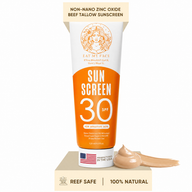
The Beef Tallow Tinted Sunscreen Tube SPF 30 is a mineral SPF 30 with one active, non-nano zinc oxide, carried in grass-fed beef tallow and organic plant oils instead of water. Broad spectrum, water resistant for 80 minutes, lightly tinted with organic cocoa powder so it rubs in warm on the face, and a 4 oz squeeze tube with enough in it for a whole body. Every ingredient is food-grade, and it is made in Eugene, Oregon. If you're covering more than a face, the 2-pack is the sane buy.
For a plain moisturizer on the days you're indoors: The Baby & Momma Cream is the fragrance-free one, built on grass-fed beef tallow, shea butter, cocoa butter, arrowroot powder, sea buckthorn oil, vitamin E, jojoba oil, fractionated coconut oil and cetyl alcohol.
Sources
- American Academy of Dermatology, "Sunscreen FAQs" (face: at least 1 teaspoon; body: about 1 ounce; reapply every two hours; SPF 30 blocks 97% of UVB). aad.org/media/stats-sunscreen
- 21 CFR § 201.327, Over-the-counter sunscreen drug products; required labeling based on effectiveness testing (paragraph (g): "sunblock," "sweatproof," "waterproof" are misleading; water resistant 40 or 80 minutes). Legal Information Institute, Cornell Law School. law.cornell.edu/cfr/text/21/201.327
- Smijs TG, Pavel S. "Titanium dioxide and zinc oxide nanoparticles in sunscreens: focus on their safety and effectiveness." Nanotechnology, Science and Applications, 2011. PMC3781714
- Russell MF, Sandhu M, Vail M, Haran C, Batool U, Leo J. "Tallow, Rendered Animal Fat, and Its Biocompatibility With Skin: A Scoping Review." Cureus, 2024. PMC11193910
Ready to try it? Beef Tallow Tinted Sunscreen Tube SPF 30 is in stock and ships fast — $24.99. 180 days to decide.

