

Best Non Toxic Sunscreen in 2026: The 6 Label Checks That Matter (and Why Non-Nano Zinc Wins)
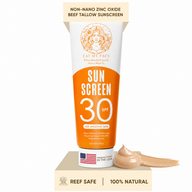
The best non toxic sunscreen is a mineral one: non-nano zinc oxide as the only active ingredient, "broad spectrum" and SPF 30 on the front, "water resistant (80 minutes)" on the back, none of the oxybenzone family in the Drug Facts box, and an inactive list you could cook with. "Non-toxic" itself is not a seal anyone awards. The FTC's Green Guides treat it as a claim the seller has to be able to prove, for people and for the environment, and nobody checks before it goes on a bottle. So the front of the tube tells you nothing and the back tells you everything. Run the six checks below and the sunscreen that passes all of them is a non-nano zinc formula carried in fats your skin already recognizes, which is how we built our Beef Tallow Tinted Sunscreen Tube SPF 30: one active, grass-fed beef tallow and organic plant oils instead of water, and a very light organic cocoa tint so the zinc rubs in warm instead of ghost-white.
What "non toxic sunscreen" means, and what the front of the tube can't promise
Search that phrase and you get a wall of ranked lists, most of them scored by a database that rates each ingredient alone and then adds up the fear. That is not how skin works, and it is not how the law works either. Under the FTC's Green Guides (16 CFR 260.10) it is deceptive to claim a product is non-toxic unless you hold "competent and reliable scientific evidence" that it is non-toxic for humans and for the environment generally. Nobody reviews the claim first; it is a promise the seller makes, and you are the one left to audit it.
What people mean by the phrase is more specific than the word: an active ingredient that stays on the surface of the skin instead of soaking in, a mineral filter rather than a synthetic UV absorber, a base made of things with names they recognize, and nothing that washes off into the sea as something a reef has to cope with. That is a shopping list, not a slogan, and a label can be held up against it in about forty seconds.
One fair note before the list. The AAD points out that the FDA asking for more safety data on the chemical filters is not the same as calling them unsafe. Zinc oxide never entered that conversation: the FDA proposed it in 2019 as one of only two filters generally recognized as safe and effective, and when the particles are non-nano it works from the top of the skin, where you can wash it off.
The 6 label checks for the best non toxic sunscreen
Flip the tube over. Everything you need is in the Drug Facts box and the inactive list under it, and the checks run top to bottom in the order the panel prints them.
1. Is zinc oxide the active ingredient, and is it labeled non-nano?
The box opens with "Active ingredient." You want zinc oxide there, labeled non-nano, and ideally nothing beside it. One mineral covers the whole UV range: a 2011 review in Nanotechnology, Science and Applications describes titanium dioxide as "primarily a UVB absorbing compound, while ZnO is more efficient in UVA absorption." UVA is the aging end of the spectrum, the part that comes through window glass. Zinc handles it.
2. Does the front say "broad spectrum" and at least SPF 30?
"Broad spectrum" is the FDA's term for a sunscreen that covers UVA as well as UVB. SPF 30 is the floor the AAD recommends because it filters about 97% of UVB, and no sunscreen reaches 100%. A bigger number on another brand's label does not buy you more time outside; it needs reapplying on the same two-hour clock. Ours says SPF 30, and we are happy with the number.
3. Does it say "water resistant (40 minutes)" or "(80 minutes)"?
Those are the only two water-resistance claims the FDA's labeling rule (21 CFR 201.327) lets a sunscreen print, and the minutes come from a timed soak. "Waterproof," "sweatproof" and "sunblock" are on the same rule's list of claims that make a sunscreen misbranded, so one of those on the front tells you whoever wrote the label did not read the rule. Our tube says 80 minutes. After that, or after a towel, put more on.
4. Can you picture the top five inactive ingredients?
This is the check the fear-score lists skip. Inactives are listed in descending order by weight, so the first five names are most of what is in the tube. A conventional sunscreen opens with water, then an emulsifier to hold water and oil together, then a preservative system to keep that water from growing things. A tallow sunscreen opens with grass-fed beef tallow, shea butter, cocoa butter and plant oils, because there is no water to emulsify or preserve. If the first five names could live in your kitchen, you are holding the sunscreen you were searching for.
5. Is the oxybenzone family absent?
Oxybenzone, octinoxate, octocrylene and avobenzone are the four chemical filters people are trying to get away from; sunscreens containing the first two have been banned from sale in Hawaii since 2021 over coral damage. A mineral sunscreen needs none of them. One turning up as a second active beside zinc oxide makes it a hybrid, whatever the front says.
6. Does the scent have a name?
Labeling rules let a company list an entire scent blend as the single word "fragrance." Ours smells like cookies because there is organic cocoa powder and vanilla oleoresin in the tube, both printed on the list. If a label says "fragrance" and stops there, you do not know what is in it.

Non nano zinc oxide sunscreen: why particle size is the whole point
"Non-nano" means the zinc oxide particles are larger than 100 nanometers, the usual cutoff for a nanoparticle. Makers shrank zinc oxide into the nano range because small particles go clear: the same 2011 review notes that zinc oxide particles of 200 nanometers or smaller are "virtually transparent," which is cosmetically lovely and comes, in the authors' words, "at the expense of broad UVA protection." Non-nano particles keep the UVA coverage and sit on top of the skin, where a sunscreen is supposed to be.
Here is the part the "mineral sunscreen reflects the sun like a mirror" explainers get wrong. Zinc oxide is a semiconductor. It deals with UV mainly by absorbing it inside the particle and releasing it as a trace of heat, with only a small share scattered off the surface; Cole and colleagues put the absorbed share at roughly 95% in a 2016 paper in Photodermatology, Photoimmunology & Photomedicine. The particle is not a mirror. It is a sponge for UV that is too big to go anywhere, which is the entire case for non-nano zinc in one sentence.

Is non nano zinc oxide safe, and is it natural?
Zinc oxide is a mineral compound, zinc and oxygen, with well over a century of use on skin. "Natural" is the slipperier word. The zinc oxide in any sunscreen is refined from mined zinc, not scooped out of a riverbed, so call it a mineral filter rather than a wild-harvested one. What makes a sunscreen natural in the way people mean it is the base. Ours is grass-fed beef tallow with shea butter, cocoa butter, sea buckthorn oil and other organic plant oils, plus the cocoa powder and vanilla oleoresin behind the smell, and every ingredient is food-grade.
Nano vs non nano zinc oxide: which is better?
Nano wins on invisibility. Non-nano wins on UVA coverage and on staying put: the review found the nanoparticles studied "can penetrate from the formulation into the deepest human SC layer close to viable epidermal cells but generally remain in the upper part," the SC being the stratum corneum, your dead outer layer. If you are reading about non toxic sunscreen because you would rather the active stayed on the outside, non-nano is your answer, and the white cast it is famous for is a formulation problem with a fix: we tint ours with organic cocoa powder so the zinc rubs in warm instead of chalk-white. Our post on why size matters in non-nano zinc oxide sunscreen goes deeper on the particle science, and zinc oxide vs chemical sunscreen covers the filters it replaces.
How to use a mineral sunscreen so the SPF 30 on the label is the SPF 30 you get
A mineral sunscreen is a film of particles, so the protection you get depends on that film being thick enough and even. The AAD's numbers: at least a teaspoon for your face, about an ounce (a shot glass) for your body, applied to dry skin 15 minutes before you go out, and reapplied roughly every two hours or after swimming or sweating. Our tube adds one step. Shake it. The zinc settles between uses, and a good shake keeps the film even.
Rub until the white disappears, then give it about five minutes before clothes go on; an oil-and-mineral sunscreen can transfer to fabric while it is still on top of the skin. After 80 minutes in the water, or whenever you towel off, put more on. The complete guide to tallow mineral sunscreen has the long version, including how to pick one.

Why grass-fed beef tallow belongs in a sunscreen
Most sunscreens are built on water because water is cheap and makes a light lotion. The cost is everything water drags in with it: an emulsifier, a preservative, and a base that evaporates and leaves the zinc in a chalky film. Tallow is the opposite approach. A 2024 scoping review in Cureus describes rendered beef tallow as "rich in triglycerides, specifically oleic acid, palmitic acid, stearic acid, and linoleic acid," and lists the same fatty-acid families among the key lipids of the epidermis, which is why tallow has been a skin fat for so long. In a sunscreen that compatibility does two jobs. It carries the zinc so the film spreads evenly instead of pilling, and it moisturizes while it sits there, so you come in from a day outside with skin that feels like it had a moisturizer on. It did.
With no water in the tube there is nothing to preserve, so the formula stays short: the antioxidants in sea buckthorn oil help keep it stable without a synthetic preservative. One active, a short list, every line of it edible-grade. If your goal is fewer unpronounceable things on your skin, a tallow base deletes most of the list in one move. Our five-point label test for non toxic skin care applies the same thinking to the rest of your routine.
The one that passes all six checks
Our Beef Tallow Tinted Sunscreen Tube SPF 30 has non-nano zinc oxide as its only active, broad spectrum, water resistant (80 minutes), carried in grass-fed beef tallow and organic plant oils with no water, and tinted with organic cocoa powder so it rubs in warm. 4 oz squeeze tube, made in Eugene, Oregon.
Pair it with a plain moisturizer. The Baby & Momma Cream is the fragrance-free one, built on grass-fed beef tallow, shea butter, cocoa butter, arrowroot powder, sea buckthorn oil, vitamin E, jojoba oil, fractionated coconut oil and cetyl alcohol.
Quick answers
What is the best non toxic sunscreen for face?
A non-nano zinc oxide sunscreen with a tint, so you will actually wear enough of it. Our Beef Tallow Tinted Sunscreen Tube SPF 30 uses organic cocoa powder for the tint, which keeps the zinc from going ghost-white on your face. Use at least a teaspoon, the AAD's minimum, and reapply every two hours outside.
Is non nano zinc oxide safe?
Zinc oxide is one of the two sunscreen filters the FDA proposed as generally recognized as safe and effective in 2019, and it has been used on skin for well over a century. Non-nano particles are larger than 100 nanometers, so they stay on the surface of the skin. That size is the reason people who want their sunscreen on the outside ask for it by name.
What does non nano mean in sunscreen?
It means the zinc oxide particles are bigger than 100 nanometers, the usual cutoff for a nanoparticle. Nano-sized zinc goes transparent in a cream but gives up some UVA coverage; non-nano keeps the broad-spectrum coverage and shows as a white cast unless the formula is tinted. Non-nano describes size only, not whether the particle is coated.
Does non nano zinc oxide leave a white cast?
Plain non-nano zinc does, because the particles are large enough to scatter visible light. Two things fix it: rubbing the sunscreen in until the white disappears, and a tint. We use a very light organic cocoa tint rather than iron oxides or dyes, so the zinc rubs in warm.
Which sunscreen ingredients are people trying to avoid?
Oxybenzone, octinoxate, octocrylene and avobenzone come up most. Hawaii has banned the sale of sunscreens containing oxybenzone or octinoxate since 2021 over coral damage, and the FDA has asked for more safety data on most of the chemical filters. A mineral sunscreen with zinc oxide as its only active contains none of them.
Is uncoated zinc oxide the same as non nano?
No. Non-nano is about particle size; uncoated means the particle has no surface treatment, usually a silicone, to help it spread through a formula. A zinc oxide can be coated or uncoated at any size. Labels rarely say which, so if coating matters to you, ask the maker.
Sources
- American Academy of Dermatology. "Sunscreen FAQs." aad.org
- Federal Trade Commission. Guides for the Use of Environmental Marketing Claims, 16 CFR § 260.10, "Non-toxic claims." law.cornell.edu
- Smijs TG, Pavel S. "Titanium dioxide and zinc oxide nanoparticles in sunscreens: focus on their safety and effectiveness." Nanotechnology, Science and Applications, 2011;4:95–112. PMC3781714
- Russell MF, Sandhu M, Vail M, Haran C, Batool U, Leo J. "Tallow, Rendered Animal Fat, and Its Biocompatibility With Skin: A Scoping Review." Cureus, 2024. PMC11193910
Ready to try it? Beef Tallow Tinted Sunscreen Tube SPF 30 is in stock and ships fast — $24.99. 180 days to decide.

