

Is Tallow Sunscreen Effective? It Depends What's in the Jar
Tallow sunscreen is effective when, and only when, zinc oxide is doing the UV work. Tallow on its own is not a sunscreen: in lab testing, plain oils and fats measure around SPF 2 to 8, with no broad-spectrum coverage and no water resistance. A well-made tallow sunscreen uses tallow as the base and roughly 20% non-nano zinc oxide as the active ingredient, and a tested formula like that earns a genuine, printed-on-the-label SPF 30. The tallow makes it feel great. The zinc makes it work.
We should be upfront about our bias: we make a tallow sunscreen. You'd expect us to answer "yes" and hustle you toward the buy button. But this question deserves the real answer, because the tallow corner of the internet is split between properly tested mineral formulas and jars of rendered fat wearing sunshine-flavored wishful thinking on the label. One of those is effective. The other is a moisturizer.
Is Tallow Sunscreen Effective? Check the Active Ingredient
The word "effective" is a specific claim for sunscreen. In the US, an SPF number is an over-the-counter drug claim: the formula has to pass standardized testing on human skin before that number can legally appear on the package. So the question isn't whether tallow is nice for skin (it is). The question is whether the product in your hand passed that test. A tallow sunscreen with a zinc oxide active and a Drug Facts panel did. A jar of plain tallow never has, because it can't.
Can beef tallow be used as sunscreen by itself?
No, and the numbers are not close. A study in Pharmacognosy Research measured the in-vitro sun protection factor of common plant oils: olive and coconut scored around 8, castor around 6, almond around 5, sesame around 2. Tallow wasn't in the study, and no published SPF for it exists anywhere, but it's a fat in the same family, and nothing in that family comes near real protection. Those lab numbers are also the generous version: in-vitro estimates routinely overstate what you'd get on actual skin, and none of these fats offer meaningful UVA coverage or survive a swim.

We wrote up the plain-tallow question at length in Does Beef Tallow Work as Sunscreen? if you want the deep dive. The short version: skipping a real UV filter because tallow feels protective is how you end up very moisturized and very red.
So what makes a tallow sunscreen actually work?
Zinc oxide. In our formula that's non-nano zinc oxide — Z-Cote, the pharmaceutical grade from BASF — and it's the ingredient that earns the broad-spectrum SPF 30 and the 80-minute water resistance rating. Everything else in the tube exists to carry the zinc evenly, keep it sitting where you put it, and make the whole experience pleasant enough that you'll actually reapply.
What Tallow Actually Does in a Sunscreen (Hint: Not the SPF)
Here's the part that costs us something to admit: the tallow in our sunscreen contributes nothing measurable to the SPF number. Zero. If it did, we'd shout it from the label. It doesn't, so we won't.
What tallow does is everything around the protection. Grass-fed tallow's fatty acid profile sits remarkably close to your skin's own sebum, which is why a zinc formula in a tallow base rubs in like a moisturizer instead of sitting on you like primer-grade paint. Mineral sunscreens have a deserved reputation for feeling chalky and drying; tallow is how ours avoids both. It keeps skin comfortable through a full day outside, and it's the reason the ingredient list reads like a pantry instead of a chemistry set.
Is beef tallow a natural sunscreen?
It's a natural sunscreen base, and the distinction is the whole ballgame. "Natural SPF" is where this corner of the internet goes wrong: no fat, butter, or oil has ever earned a tested SPF worth relying on. If a tallow product implies sun protection but lists no active ingredient, it isn't a natural sunscreen. It's a moisturizer being marketed with a suntan's worth of optimism.
And about the zinc, one myth worth retiring: non-nano zinc particles are too large to slip past your outer skin layer, so they sit on the surface. They are not tiny mirrors, though, whatever the marketing says. Zinc oxide absorbs the large majority of the UV that reaches it and converts it to a trivial amount of heat; only a small fraction gets scattered away. It also covers UVA-1 better than any other single filter, the slice of the spectrum most responsible for long-term visible skin aging.
How to Spot an Effective Tallow Sunscreen
The label does the sorting for you, if you know where to look.

A tested tallow sunscreen has a Drug Facts panel with zinc oxide listed as the active — right around 20% is the sweet spot for reaching SPF 30 without the texture going full spackle. It says "broad spectrum," states a water resistance time (80 minutes is the maximum any sunscreen can claim), and specifies non-nano particle size. Our complete guide to tallow mineral sunscreen walks through each checkpoint if you're comparing brands. And if your skin situation involves anything medical, ask your dermatologist before switching sunscreens.
If the DIY itch strikes, we published our own tallow sunscreen recipe rather than gatekeep it. But go in knowing homemade sunscreen has one unfixable flaw: you cannot verify the SPF you actually made. Zinc clumps and settles, so a home batch can be one number in one stripe and a much smaller number an inch away, and there's no way to know which stripe you're wearing until the sun tells you.
SPF 30 Still Needs You to Apply It Right
One last honest wrinkle. SPF 30 describes the formula when it's applied the way the test lab applies it, which is more generously than almost anyone does at the beach. The American Academy of Dermatology's arithmetic: SPF 30 filters about 97% of UVB rays, a full adult application is about a shot glass of product (a teaspoon just for the face), and it needs redoing roughly every two hours — sooner once you've hit 80 minutes of swimming or sweating. An effective sunscreen applied thin and once is a mediocre sunscreen.

The sun day doesn't end at sunset, either. Tallow's real starring role comes after: our sunscreen and after-sun routine guide covers both halves of the day, including why the same fat that can't filter UV is exactly what sun-stressed skin wants at 8 PM.
Quick Answers
Does beef tallow sunscreen work?
Yes, when it's a genuine mineral formula: zinc oxide active around 20%, a tested broad-spectrum SPF, and a stated water resistance time. The tallow is the base, not the filter. Look for a Drug Facts panel — no panel, no sunscreen.
Can beef tallow be used as sunscreen on its own?
No. Lab testing puts plain oils around SPF 2 to 8, tallow has no published SPF at all, and none of them provide reliable UVA coverage or water resistance. Plain tallow is a fine moisturizer and a poor bodyguard.
Is beef tallow a natural sunscreen?
It's a natural sunscreen base. Tallow carries the zinc, softens the mineral texture, and keeps skin comfortable, but the UV protection comes entirely from the zinc oxide. "Natural SPF" claims with no active ingredient listed are the red flag to walk away from.
What is tallow mineral sunscreen?
A mineral sunscreen that uses grass-fed tallow as its base and zinc oxide as its only UV filter. Ours pairs tallow with non-nano zinc oxide for a broad-spectrum SPF 30 with 80-minute water resistance.
Is organic tallow sunscreen more effective?
The organic part describes the base ingredients, not the protection. Effectiveness comes from the zinc percentage and the testing behind the SPF number. Organic matters for what you're spreading on your skin every day; the SPF doesn't care either way.
Do beef tallow sunscreen reviews hold up?
The consistent praise is real: tallow formulas rub in like moisturizer, skip the chalky cast, and don't sting eyes. The reviews to ignore are the ones claiming plain tallow got someone through a whole summer, or that mineral SPF never needs reapplying. It does — about every two hours.
The one we make, so you don't have to guess
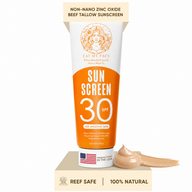
Our Beef Tallow Sunscreen SPF 30 (Mineral Tube) pairs grass-fed tallow with non-nano zinc oxide: broad spectrum, with 80-minute water resistance. The tallow handles the skin feel. The zinc handles the sun.
Sources
- Kaur CD, Saraf S. In vitro sun protection factor determination of herbal oils used in cosmetics. Pharmacognosy Research, 2010.
- Smijs TG, Pavel S. Titanium dioxide and zinc oxide nanoparticles in sunscreens: focus on their safety and effectiveness. Nanotechnology, Science and Applications, 2011.
- American Academy of Dermatology: Sunscreen FAQs.
Ready to try it? Beef Tallow Tinted Sunscreen Tube SPF 30 is in stock and ships fast — $24.99. 180 days to decide.


