

What Is Tallow Sunscreen? The Honest Guide
Quick answer: Tallow sunscreen is a mineral sunscreen — meaning the SPF comes from zinc oxide, not chemical filters — formulated in a base of grass-fed beef tallow instead of the usual synthetic emulsifiers and silicones. The zinc does the sun protection. The tallow does everything else: it carries the zinc, keeps it spreadable, and feeds your skin a fat that matches its own oil. To be clear about the part people get wrong: tallow itself has no SPF. The zinc is the sunscreen. The tallow is what makes wearing it feel like skincare instead of spackle.
So you've seen "tallow sunscreen" pop up — maybe on TikTok, maybe in a granola corner of Instagram, maybe in a panicked 1 a.m. search after reading the back of your current bottle — and you have one very reasonable question: what is this, actually?
Short version: it's mineral sunscreen with a better wardrobe. Same protective ingredient as the good mineral sunscreens (non-nano zinc oxide), just suspended in rendered grass-fed beef fat instead of the water-and-synthetics base most brands use. That swap is the whole story, and it's a bigger deal than it sounds.
We're Eat My Face — we make grass-fed tallow skincare, including an SPF 30 mineral sunscreen — so yes, we have a horse in this race. But we're also going to tell you the unglamorous truth a few times in this article, including the part where tallow does not protect you from the sun by itself. Let's get into it.
What Is Tallow Sunscreen, Exactly?
Break any sunscreen into two parts and it gets simple:
- The active ingredient — the thing that actually stops UV. In a mineral sunscreen, that's zinc oxide (sometimes titanium dioxide). In a chemical sunscreen, it's filters like avobenzone, oxybenzone, or octinoxate.
- Everything else — the base. Emulsifiers, oils, water, thickeners, preservatives, fragrance. The stuff that turns a chalky mineral powder into something you'll actually rub on your face.
Tallow sunscreen is a mineral sunscreen where that "everything else" is built around grass-fed beef tallow. The zinc oxide is still the part doing the protecting. The tallow replaces the synthetic base — the silicones, the seed oils, the chemical emulsifiers — with a single rendered fat that your skin happens to recognize on contact.
That's it. No mystery. It's not a new kind of UV protection. It's a much cleaner delivery system for the UV protection that already works. Because the active is zinc, "tallow sunscreen" and "mineral tallow sunscreen" mean the same thing — it's a mineral (zinc-based) sunscreen, just in a tallow base.
What Is a Zinc-Based Sunscreen?
A zinc-based sunscreen is a mineral sunscreen whose active ingredient is zinc oxide — a mineral that sits on the surface of your skin and physically scatters and absorbs UV before it reaches you. It's one of only two actives (the other is titanium dioxide) the FDA still recognizes as "generally recognized as safe and effective." Every tallow sunscreen worth buying is a zinc-based sunscreen; the tallow is just the base carrying the zinc.
Here's why "zinc-based" matters as its own category:
- It's broad-spectrum by nature. Zinc oxide covers both UVA (aging, deep damage) and UVB (burning) rays in a single ingredient — many chemical filters need to be combined to do that.
- It works on application. Because zinc sits on top and absorbs UV right there rather than needing to soak into skin first, there's no 15–20 minute "wait for it to activate" window that chemical sunscreens need.
- It's the go-to for sensitive skin. Zinc doesn't soak in, so it's the filter dermatologists most often steer reactive, eczema-prone, and kids' skin toward.
- "Non-nano" is the spec to look for. Non-nano means the zinc particles are large enough to stay on the surface of your skin. It's the cleaner, reef-safer version — and it's what our SPF 30 uses (non-nano zinc oxide, the only active).
So a tallow sunscreen is a zinc-based sunscreen with an upgrade: instead of suspending that zinc in water and silicone, it suspends it in a fat your skin treats like its own.
Why Put Sunscreen in Tallow at All?
Fair question. Zinc oxide will block UV whether it's floating in water, silicone, or duck fat. So why bother with tallow?
Because of what your skin does with the base. Most of a sunscreen's volume is base, and your skin spends all day wearing it. Tallow earns its spot for three reasons:
- Your skin already speaks "fat." Human skin makes its own oil (sebum), and grass-fed beef tallow has a remarkably similar fatty-acid profile — heavy on oleic and palmitic acids, the same ones your skin produces. So instead of sitting on top like an inert slick, it absorbs the way your own oil would. No "decoding" a foreign synthetic required.
- It's a barrier ingredient, not just a carrier. Tallow naturally carries the fat-soluble vitamins A, D, E, and K. So while the zinc handles the sun, the base is supporting your moisture barrier instead of stripping it the way alcohol- and silicone-heavy bases can.
- It kills the chalk. The #1 complaint about mineral sunscreen is the chalky, draggy, ghost-cast feel. A rich tallow base helps the zinc glide and blend instead of sitting on your skin like primer paint.
If you've ever abandoned a mineral sunscreen because it felt like frosting a cake with sidewalk, the base is usually the culprit — and the base is exactly what tallow fixes.
Tallow Sunscreen vs. Regular Mineral Sunscreen: 5 Real Differences
Both protect you with zinc oxide. Here's where they actually diverge.
1. The base ingredient. Regular mineral sunscreen: water, synthetic emulsifiers, silicones (dimethicone, cyclopentasiloxane), and often cheap seed oils. Tallow sunscreen: a grass-fed animal fat that mirrors your skin's own sebum. Same active, very different thing left on your skin all day.
2. The feel. Conventional mineral formulas are famous for chalk and white cast. A good tallow base softens both — it spreads warmer and blends in instead of ghosting, especially with a hint of natural tint to offset the zinc's whiteness.
3. The "could you eat it" test. This is our whole rule — if you wouldn't eat it, don't wear it. You can't say that about dimethicone or phenoxyethanol. You can say it about tallow, zinc, and the food-grade oils around them. Whether that matters to you is personal, but it's a real difference.
4. What it does beyond SPF. Regular mineral sunscreen protects and… that's roughly it. A tallow base also delivers barrier lipids and fat-soluble vitamins A/D/E/K while it sits there, so it pulls double duty as light daily skin care. (We're careful here: that's barrier support, not a medical claim.)
5. The trade-off. Honesty time — tallow-based formulas can feel richer than a thin, fast-drying conventional lotion, and clean bases without synthetic preservatives tend to have a shorter shelf life. If you want a weightless gel-cream that lasts three years on a shelf, a synthetic base wins. If you want something that feeds your skin while it protects it, tallow wins. Different priorities.
Does Tallow Have SPF? (No — and Anyone Who Says Otherwise Is Wrong)
This is the part of the internet we have to push back on, because it's the one that gets people burned. Literally.
Plain beef tallow has no SPF. Zero. There is no traditional tallow recipe that protects you from UV. The viral "just rub tallow on and skip sunscreen" advice is how people end up with lobster shoulders and a real regret arc.
In a tallow sunscreen, the protection comes entirely from the zinc oxide active. The tallow is the base — it carries and improves the zinc, but it is not blocking a single UV ray on its own. If a product is labeled as sunscreen, it has a Drug Facts panel and a tested SPF because of the active ingredient, not the fat.
So: tallow moisturizer ≠ sun protection. Tallow sunscreen (with zinc) = sun protection. Don't confuse the two on a beach day.
Is Beef Tallow a Natural Sunscreen?
No. Beef tallow is not a natural sunscreen, and using plain tallow as sun protection will get you burned. This myth spreads every summer, so let's kill it cleanly: tallow has no measurable SPF, no UV-filtering ability, and no traditional recipe changes that. A handful of blogs cite an old, misread lab reference to claim tallow has an "SPF of 2-ish" — even if that were reliable, SPF 2 blocks about 50% of UVB, which is not protection, it's a rounding error on a beach day.
Where the confusion comes from: tallow is genuinely great after sun (it rebuilds the lipid barrier UV strips) and it's the ideal base for a real sunscreen. People blur "great for your skin in the sun context" into "protects you from the sun." Those are different jobs.
What is a natural sunscreen? The mineral actives — zinc oxide and titanium dioxide — are naturally-occurring minerals, and they're the only "natural" sun protection that actually holds up to testing. So the honest version of the trend isn't "beef tallow sunscreen" (fat alone), it's a mineral tallow sunscreen: naturally-derived zinc oxide doing the protecting, in a grass-fed tallow base doing the skincare. That's what ours is. Fat feeds; zinc shields. Never ask the fat to do the zinc's job.
Is Tallow Mineral Sunscreen Good for Sensitive Skin?
This is where tallow mineral sunscreen tends to shine. Mineral (zinc) sits on top of the skin and absorbs UV right there rather than soaking into it, which is generally why dermatologists point sensitive, reactive, and eczema-prone skin toward mineral over chemical filters in the first place. Put that zinc in a fragrance-free, food-grade tallow base — instead of one loaded with synthetic fragrance and alcohol — and you've removed two of the most common irritants in one move.
As always: patch test first, especially if you've reacted to products before. "Gentle for most people" is not "guaranteed for everyone."
What Makes the Best Tallow Sunscreen: 5 Things to Check
Not all of them are created equal — and "has tallow in it" is not the same as "good sunscreen." When people search for the best tallow sunscreen, this is the checklist that actually separates the real thing from the greasy mall-kiosk version. Run down it before you buy:
- Non-nano zinc oxide as the active. "Non-nano" means the zinc particles are large enough to stay on top of your skin rather than potentially penetrating it. It's the cleaner spec, and it's what reef-safe formulas use. This is non-negotiable — it's the part doing the protecting.
- A stated, tested SPF. Look for an actual SPF number and a Drug Facts panel — that's how you know it's a real, regulated sunscreen and not a moisturizer cosplaying as one. (Ours is SPF 30, broad spectrum.) No number, no buy.
- Grass-fed, grass-finished tallow. Grass-finished fat carries far more of the vitamins A/D/E/K than grain-finished. If a brand won't say, assume the cheaper version.
- A short, readable ingredient list. The point of going tallow is dodging the synthetic soup. If the back label still reads like a chemistry final, the tallow is just marketing garnish.
- Reef-safe / no banned chemical filters. No oxybenzone, octinoxate, or octocrylene — the filters banned in Hawaii, Key West, and elsewhere for reef toxicity. The best mineral formulas skip these by design.
Hit all five and you've found a genuinely good one. Miss two or more and you're paying tallow prices for sunscreen that doesn't earn it.
For the full rundown on why particle size matters, our guide to non-nano zinc oxide goes deep — and if you're weighing mineral against chemical filters generally, start with zinc oxide vs. chemical sunscreen.
Our Pick: Eat My Face SPF 30 Tallow Sunscreen
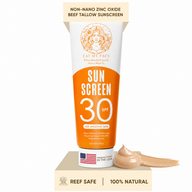
We built ours to be the answer to this whole article. Eat My Face SPF 30 Mineral Sunscreen uses non-nano zinc oxide (Z-Cote) as the only active, in a base of grass-fed, grass-finished beef tallow.
- SPF 30, broad-spectrum mineral protection
- Non-nano zinc oxide — sits on top of the skin, starts working on application
- Reef safe — none of the chemical filters banned by reef-protection laws
- Grass-fed tallow base — feeds the barrier with vitamins A/D/E/K instead of stripping it
- Edible-grade ingredients — because if you wouldn't eat it, don't wear it
It feels like skincare, not spackle — and it doesn't look like the chalky lifeguard-nose zinc of 1995.
4 oz tin. There's also a lighter Travel Tube — same SPF 30 protection with a whisper of cacao for a subtle tint, sized for tossing in a beach bag and reapplying on the go (which, real talk, you should be doing every two hours). The whole family lives in our beef tallow sunscreen collection if you want to browse everything in one place.
Sunscreen is step one — but if you're already pink and tight, reach for something built to soothe and comfort sun-exposed skin. Our Aloe + Cucumber After-Sun Balm pairs cooling aloe and cucumber with grass-fed tallow — ingredients you could literally eat.
SPF 30 is back in stock — shop the 4 oz tube →
FAQ — Tallow Sunscreen
Q: What is tallow sunscreen?
Tallow sunscreen is a mineral sunscreen — its SPF comes from zinc oxide — formulated in a base of grass-fed beef tallow instead of synthetic emulsifiers, silicones, and water. The zinc oxide provides the UV protection; the tallow makes it spread well, absorb like your skin's own oil, and deliver barrier-supporting fats and vitamins. It is real, regulated sunscreen as long as it carries a tested SPF and a Drug Facts panel.
Q: Is beef tallow a natural sunscreen?
No. Beef tallow has no SPF and provides no UV protection on its own — using plain tallow as sunscreen will get you burned. The "natural sunscreen" in a tallow product is the mineral active, zinc oxide (a naturally-occurring mineral). A real mineral tallow sunscreen is zinc oxide doing the protecting in a tallow base doing the skincare. Fat feeds the skin; zinc shields it.
Q: What is a zinc-based sunscreen?
A zinc-based sunscreen is a mineral sunscreen that uses zinc oxide as its active ingredient. Zinc sits on the surface of the skin and absorbs about 95% of both UVA and UVB rays (scattering the rest), making it broad-spectrum in a single ingredient. It works on application (no wait time), and it's the filter most recommended for sensitive and kids' skin. "Non-nano" zinc means the particles stay on the skin's surface — the cleaner, reef-safer spec.
Q: Does tallow have SPF on its own?
No. Plain beef tallow has no SPF and provides no measurable UV protection. In a tallow sunscreen, the protection comes entirely from the zinc oxide active — the tallow is the base. Never use a plain tallow moisturizer as sun protection.
Q: Is tallow sunscreen real sunscreen?
Yes — if it contains an active mineral filter (zinc oxide) and carries a tested SPF rating and Drug Facts label, it's a real, regulated sunscreen. What makes it "tallow" sunscreen is the base ingredient, not a different kind of protection. A tallow moisturizer without zinc is not sunscreen.
Q: What's the difference between tallow sunscreen and regular mineral sunscreen?
Both protect you with zinc oxide. The difference is the base: regular mineral sunscreen suspends the zinc in water, synthetic emulsifiers, and silicones, while tallow sunscreen suspends it in grass-fed beef fat that mirrors your skin's own sebum. The result is usually less chalk, less white cast, added barrier lipids and vitamins A/D/E/K, and a fully food-grade ingredient list.
Q: Is tallow mineral sunscreen reef safe?
Tallow mineral sunscreens that use non-nano zinc oxide and skip the banned chemical filters (oxybenzone, octinoxate, octocrylene) are considered reef safe. Our SPF 30 is formulated specifically to qualify. Always check the active and inactive ingredient list to confirm.
Q: Is tallow sunscreen good for sensitive or acne-prone skin?
Mineral sunscreen is generally the gentler choice for sensitive and reactive skin because zinc sits on top of the skin rather than absorbing in. A fragrance-free tallow base removes two more common irritants (synthetic fragrance and drying alcohols). Tallow is non-comedogenic for most people because it resembles your own sebum, but everyone's skin is different — patch test first.
Q: Can I make tallow sunscreen at home?
Please don't. DIY tallow-and-zinc recipes can't guarantee even zinc dispersion, accurate particle size, or an actual tested SPF — which means you have no idea how much protection you're getting, and "some" is dangerously easy to mistake for "enough." Sunscreen is one of the few skincare products worth buying from someone who tested it. Make the body butter at home; buy the SPF.
Q: Can I wear tallow moisturizer under my sunscreen?
Yes. A thin layer of tallow moisturizer under a mineral sunscreen is a fine routine — just let it absorb for a few minutes first, and remember the sunscreen (the zinc) is the part doing the protecting. If you want both in one step, a tallow sunscreen already combines them.
The Bottom Line
Tallow sunscreen isn't a gimmick or a new physics of sun protection. It's the mineral sunscreen you already trust — zinc oxide — wrapped in a base your skin actually recognizes, minus the synthetic soup. The zinc protects; the tallow makes you want to wear it (and feeds your skin while you do).
Just keep the one rule straight: the zinc is the sunscreen, the tallow is the upgrade. Plain fat won't save your shoulders — but tallow sunscreen will, and it'll feel a lot better doing it.
Related Reading
- Natural Sunscreen Alternatives: What Actually Works — where mineral sunscreen ranks against everything else.
- Zinc Oxide vs. Chemical Sunscreen: 7 Differences That Matter — why we picked mineral, with the data.
- Why Size Matters: Non-Nano Zinc Oxide Explained — the particle-size deep dive.
- Sunburn Stages & Recovery Timeline — for when prevention didn't quite happen.
- Aloe vs Tallow vs Coconut Oil for Sunburn — the after-sun ingredient face-off.
- Beef Tallow for Sunburn: A Skin Repair Guide — for when prevention didn't quite happen.
- SPF 30 Tallow Sunscreen — $24.99 — the product behind this guide.
If you wouldn't eat it, don't wear it.
— Eat My Face
Next steps
Once you know what tallow sunscreen is, these cover using it well.
- How much sunscreen do you actually need? — most people apply a quarter to half the tested dose
- Is tallow skincare sustainable? — where the tallow in your SPF actually comes from
Ready to try it? Beef Tallow Tinted Sunscreen Tube SPF 30 is in stock and ships fast — $24.99. 180 days to decide.


