

Is There a Natural Sunscreen? The 30-Second Label Test That Settles It
Yes, but only one kind earns the name, and it is not whichever bottle prints "natural" in the biggest font. A real natural sunscreen is a mineral sunscreen whose Active Ingredients line contains zinc oxide, titanium dioxide, or both — the two UV filters the FDA still classifies as generally recognized as safe and effective. Everything else sold as natural sun protection (coconut oil, raspberry seed oil, carrot seed oil, beef tallow) measures somewhere between SPF 2 and SPF 8 in a lab dish, which is not a number you can plan a beach day around. The word on the front of the bottle is unregulated. The Drug Facts panel on the back is not. Flip it over — that thirty-second habit is the entire answer.
Is There A Natural Sunscreen? Short Answer, Then The Long One
Sunscreen in the United States is not a cosmetic. It is regulated as an over-the-counter drug, which is why every legitimate bottle carries a Drug Facts panel with a standardized Active Ingredients line. That panel is the only part of the package anyone has to defend. The front is advertising.
Which is why "natural" has no legal definition here. Neither do "sport," "sensitive skin," or "reef safe" — the American Academy of Dermatology says plainly that the FDA has not defined those terms. They cost a brand nothing to print. One word you won't find on a U.S. sunscreen label at all is "sunblock" — our natural sunscreen guide explains why, and what actually works instead. We sell a sunscreen with "reef safe" sitting right there in its own product URL, so read that as a confession, not a swipe at anybody else.
What "natural sunscreen" reliably means in practice is mineral: the UV filtering is done by zinc oxide or titanium dioxide rather than by organic filters like avobenzone or oxybenzone. And here is the part most clean-living blogs skip. Zinc oxide is mined, refined and milled in a factory. It is a mineral, not a plant. Nobody presses it out of a seed, and there is no version of it that grows.
So the honest shape of the answer: a natural sunscreen does exist, it is a mineral one, and the word "natural" is doing less work in that sentence than the label implies. For the full teardown of the category, we went deeper in what all natural sunscreen actually gets you.
The 30-Second Label Test For Any "Natural" Sunscreen
You do not need to research a brand to know whether its sunscreen is real. You need thirty seconds and the back of the bottle. Every claim that matters is standardized by regulation, and every claim that isn't standardized is a vibe.
Step one: find the Drug Facts panel. If a product does not have one, it is not a tested sunscreen, no matter what the front says. Step two: read the Active Ingredients. Zinc oxide or titanium dioxide alone means mineral. Anything else means an organic filter, which is fine and effective, just not what you came for. Step three: check that it says "Broad Spectrum" (tested against UVA and UVB, not just the rays that burn you), that the SPF is 30 or higher, and that water resistance reads 40 or 80 minutes — those are the only two numbers allowed on a US label.

Then ignore the front. "Sport," "sensitive skin," and "reef safe" are undefined. So is "natural." A tinted mineral formula and a glittery beach spray can both wear the word.
Natural Sunscreen Without Chemicals: What That Phrase Can And Can't Mean
Zinc oxide is a chemical compound. So is water, so is the tallow in our jars, so is everything you have ever put on your skin. A sunscreen without chemicals is not a thing that can exist, and any brand promising you one is either confused or counting on you being confused.
What people actually mean by the phrase is worth taking seriously, though: they want the UV filters that stay on the surface rather than the ones that absorb into the body. That is a reasonable preference, and mineral formulas are the answer to it. A narrative review of sunscreens published in Skin Health & Disease in 2024 notes there is minimal penetration of the mineral filters beyond the stratum corneum — the dead outer layer. If that is your priority, ask for zinc oxide by name instead of asking for "no chemicals," and you will actually get what you want. The filter-by-filter version is in zinc oxide sunscreen vs chemical sunscreen.
What The Natural Sunscreen Alternatives Actually Measure
This is where the category gets genuinely dishonest, so here are numbers instead of adjectives. Kaur and Saraf tested a spread of common cosmetic oils by spectrophotometry in 2010 and published the in-vitro SPF values: olive oil and coconut oil came out around 8, castor oil around 6, almond oil around 5, sesame oil around 2. Peppermint and tulsi essential oils hit roughly 7, lavender about 6, tea tree about 2.
An SPF of 8 sounds like something until you convert it. SPF 15 filters about 93% of UVB and SPF 30 filters about 97%, per the AAD — the curve is steep at the bottom, so single digits leave a lot through. And these were in-vitro readings taken in a lab dish, not on human skin under a lamp, which is a far more forgiving test than the one a labeled sunscreen has to pass.

Is Beef Tallow A Natural Sunscreen?
No. We sell tallow for a living and we will still tell you no.
Tallow was not in that study, and there is no published SPF for it, which by itself should settle the question — you cannot rely on a number nobody has measured. Tallow is a superb occlusive whose fatty acid profile lines up closely with human sebum, and that is a real and useful thing. It is not UV filtering. In our own sunscreen the tallow is the vehicle: it carries the zinc, keeps the film flexible, and stops the whole thing from feeling like drywall compound. The zinc does 100% of the sun work. If someone tells you rendered fat is sun protection, they are selling you something with worse margins than they think.
Natural Alternatives To Sunscreen That Do Something Real
Shade between roughly 10am and 4pm. A wide-brimmed hat. Tightly woven or UPF-rated clothing, which does not wear off, rub off, or need reapplying. Sunglasses. Timing your run for the early morning. None of it is exciting and all of it works, which is the opposite of how the supplement aisle is arranged. We ranked the whole field in natural sunscreen alternatives that actually work.
The Honest Limits Of Mineral Sunscreen
Mineral is the answer to this question, and it comes with a bill.
The SPF on a label is a lab measurement taken at a specific, generous application thickness. Most people apply a thinner coat than that, especially with mineral formulas, precisely because a thin coat is what makes the cast disappear. You get the cosmetic result you wanted and a fraction of the SPF you paid for. Reapply every two hours, and sooner if you have been in water — water resistance tops out at 40 or 80 minutes, and that is a ceiling, not a promise.
There is also the cast itself. Zinc oxide does not bounce UV off your face like a tiny mirror; it absorbs it, which is why the mineral-versus-chemical framing is shakier than it sounds. What zinc does reflect is visible light, and that is the entire source of the white sheen. Ours leans on organic cacao powder and warm-toned sea buckthorn oil to push the film warm instead of ghostly, and the travel tube is tinted enough to disappear in about twenty seconds of rubbing. On deeper skin tones it is still visible, and we would rather say that here than let you discover it on camera.

Best Natural Sunscreen For Face: What Changes
Faces are where people cheat on quantity, and faces are the part of you that is out in the light every single day. A tinted mineral formula helps twice here — it cancels the cast and lets you apply a full layer without looking chalky. Look for a higher zinc percentage in a thinner base, and give it a couple of minutes to settle before makeup. Our longer walkthrough lives in natural sunscreen for face: the honest guide, and if the ocean side of the question is what is bugging you, start with why non-nano zinc matters for skin and oceans.
Want the version that passes its own test?
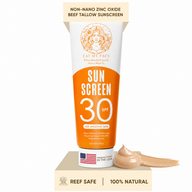
Our SPF 30 Mineral Sunscreen Tube lists exactly one active ingredient: non-nano zinc oxide. Broad spectrum, tinted with organic cacao so it blends warm rather than white, in a grass-fed tallow base. Flip it over and run us through the same three steps we just gave you — we would rather you read the panel than trust our font.
Quick Answers
Is there a natural sunscreen that actually works?
Yes — a mineral one. Zinc oxide and titanium dioxide are the only two UV filters the FDA currently classifies as generally recognized as safe and effective, and they are what "natural sunscreen" means in any useful sense. Plant oils marketed as natural sun protection measure SPF 2 to 8 in a lab dish, which is not enough to build a day around.
What is the best natural sunscreen?
The one whose Active Ingredients line reads zinc oxide and nothing else, that says Broad Spectrum, that is SPF 30 or higher, and that you will actually reapply. The AAD's advice is blunt on the last point: the best sunscreen is the one you use again and again. Everything else on the front of the bottle is marketing.
Is beef tallow a natural sunscreen?
No, and we sell tallow. There is no published SPF for beef tallow, so any claim about its sun protection is a guess. Tallow is an excellent occlusive moisturizer with a fatty acid profile close to human sebum. In a mineral sunscreen it is the base carrying the zinc, and the zinc is doing all the UV work.
What is a natural sunscreen made of?
A mineral UV filter — zinc oxide, titanium dioxide, or both — suspended in an oil or cream base. The filter is a milled mineral powder, not a plant extract, which is the detail most "natural" marketing quietly skips. The base is where the natural part genuinely lives: tallow, shea, jojoba, beeswax.
Are there natural alternatives to sunscreen?
Not as a replacement, but shade, wide-brimmed hats, UPF-rated clothing and avoiding peak midday sun all reduce your exposure and never wear off. Treat them as the foundation and sunscreen as the layer that covers what fabric cannot. No oil, seed extract or supplement is a substitute for a tested filter.
What is the most natural sunscreen for your face?
A tinted, non-nano zinc oxide formula in a simple base, applied thickly enough to actually reach its labeled SPF. Tint is the practical trick: it cancels the white cast so you stop under-applying to avoid looking chalky. Give it two minutes to set before anything goes on top.
Sources
- American Academy of Dermatology — How to decode a sunscreen label (active ingredients, broad spectrum, SPF percentages, 40/80-minute water resistance, and the terms the FDA has not defined)
- American Academy of Dermatology — How to select a sunscreen
- Kaur CD, Saraf S. In vitro sun protection factor determination of herbal oils used in cosmetics. Pharmacognosy Research. 2010;2(1):22–25
- Salih H, Psomadakis C, George SMC. Sunscreens: a narrative review. Skin Health & Disease. 2024;4(6):e432
Ready to try it? Beef Tallow Tinted Sunscreen Tube SPF 30 is in stock and ships fast — $24.99. 180 days to decide.


