

Same Beach, Same Sun. Two Very Different Sunscreens.
Two friends. One beach. One sun doing exactly what the sun does. The only variable is what each of them reached for in the beach bag. We made a 60-second film about it — watch first, then let's talk about what's actually happening on their skin.
Same beach, same sun — so what's the difference?
One guy grabs the aerosol spray: pssst, a four-second fog, done. The other rubs in a cocoa-tinted cream that looks a little like… well, food. Then they both walk off to the same waves under the same UV index. On the surface — pun fully intended — they did the same thing. Underneath, they did two completely different things.
The spray soaks in. The cream stays on top.
Chemical sunscreens — the kind in most sprays — work by absorbing into your skin and soaking up UV, then converting it to heat. That's the whole mechanism: sink in, then work. In 2019 and 2020, FDA maximal-use trials found six common chemical UV filters showed up in people's bloodstream after a single day of normal use — above the agency's own 0.5 ng/mL threshold for further safety study.
To be fair, because we're not here to fearmonger: "absorbed" is not the same as "proven harmful." The FDA didn't call these filters dangerous. It said they're absorbed enough that the long-term effects need more study, and that study isn't finished. "We don't know yet" is the honest headline.
Mineral sunscreen does the opposite. Our SPF 30 is built on non-nano zinc oxide — a mineral filter that sits on the surface like a microscopic sponge and absorbs about 95% of UV before it gets any further (a little scatters). Non-nano means the particles are too big to be absorbed, so the zinc stays exactly where you want it: on top, doing its job. (Want the full chemistry? Here's our chemical vs. mineral breakdown.)
Why we start with beef tallow
Under the zinc, our base is grass-fed beef tallow — and yes, that's the part that raises eyebrows. Tallow shares more than half of its fatty acids — oleic, palmitic, stearic — with human sebum, the oil your skin already makes. Your skin treats it as something familiar, not foreign. Biocompatible, in the technical term. So instead of a chalky white paste that just sits there, you get a lightly cocoa-tinted cream that absorbs UV on top while conditioning the skin barrier underneath the fatty acids it already uses.
It's reef-safe, too: non-nano zinc oxide isn't among the filters banned in reef-protected waters, and there's no oxybenzone or octinoxate anywhere in it.
That's the whole point of the film. Same beach. Same sun. One formula works against your skin; the other works with it.
Meet the SPF 30
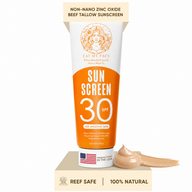
Eat My Face SPF 30 is a broad-spectrum mineral sunscreen — non-nano zinc oxide over a grass-fed tallow base, reef-safe, with a warm-toned base that softens the ghost-face cast that gave old-school mineral sunscreen a bad name.
Making a whole day of it? The sunscreen + after-sun duo pairs it with our After Sun balm — block first, soothe second.
If you wouldn't eat it, don't wear it.
FAQ
Is the sunscreen in the video chemical or mineral?
Eat My Face SPF 30 is a mineral sunscreen. It uses non-nano zinc oxide, which sits on the surface of your skin and absorbs about 95% of UV right there, rather than a chemical filter that soaks into the skin.
What SPF is Eat My Face sunscreen?
SPF 30, broad-spectrum, and built on non-nano zinc oxide over a grass-fed beef tallow base. Reef-safe.
Why is the cream tinted?
It's lightly cocoa-tinted so it blends into skin instead of leaving the chalky white cast old-school mineral sunscreen is known for. The tint is purely cosmetic — the sun protection comes from the zinc oxide.
Ready to try it? Beef Tallow Tinted Sunscreen Tube SPF 30 is in stock and ships fast — $24.99. 180 days to decide.


